Kalyan-Dombivli Culture Guide
Table of Contents
Kalyan-Dombivli Traditions & Culture: Show Up Right
Kalyan-Dombivli is old-soul Maharashtra with suburban hustle. Trains spill out at Kalyan Jn., Dombivli, Thakurli and Kopar; lanes in Ramnagar and Phadke Road wake with aarti bells; the Ulhas River glints near Durgadi; evenings in Khadakpada and Tilak Chowk shift from office chatter to bhajan, garba, or qawwali depending on the month. First-timers often miss small courtesies—where to leave chappals, how to receive prasad, when to skip photos, which side of the road to stand during visarjan. This OurCity.in guide keeps it simple, respectful, and very local.
🪔 Why This Culture Guide Works for Kalyan-Dombivli
You want the how—not just the what. Here you’ll find:
-
Month-wise festival map (Jan–Dec) with “reach by” time cues.
-
Clear etiquette across temples, gurdwaras, dargahs/mosques, churches, and river ghats.
-
Ready phrases in Hindi/Marathi (Devanagari + transliteration).
-
Local neighbourhood pointers—Durgadi, Rambaug, Manpada, Shahad, Sonarpada, Patri Pul, Katemanivali, Wayale Nagar, Bazar Peth, Pendharkar College area, MIDC (Phase II), Ramnagar, Thakurli, Kopar, Pisavli, Kolegaon, Patharli—so you feel at home.
-
Seasonal playbooks: summer heat, monsoon puddles, festive peak.
-
Practical ₹ ranges for offerings and snacks near venues.
Use this as a nudge, not a rulebook. Timings, routes, and restrictions change—always check the temple trust’s noticeboard/app, the masjid announcements, parish boards, or KDMC/city police advisories on event days.
🪔 Festival Calendar: What Happens When (Jan–Dec)
City Highlights Month by Month
January
-
Makar Sankranti (tilgul exchange; kites in open grounds around Kolegaon/Manpada). Dress modest; carry a light shawl for early morning chill (16–20 °C).
-
Republic Day: School bands and community flag hoistings at chowks (Tilak Chowk, Shivaji Chowk). Photographs okay—avoid blocking the flag mast.
February
-
Maghi Ganesh/regular monthly sankashti fasts bring extra footfall at local Ganesh mandirs in Dombivli East/West.
-
Mahashivratri: Big flow to nearby Ambreshwar (Ambarnath) and Birla Mandir (Shahad hills); pre-dawn to late night queues. Carry socks—stone floors get cold.
March
-
Holi/Rangpanchami: Many societies keep “dry colours” rules. Around Ramnagar and Pendharkar College zone, water-saving notices are common. Keep your phone bagged; ask before applying gulal.
-
Ramzan begins (varies): Iftar stalls appear near Bazar Peth and station roads—respect prayer times and avoid loud music near mosques.
April
-
Gudi Padwa: Maharashtrian households in Wayale Nagar, Rambaug, and Phadke Road raise the gudi at doorways by morning. Shobha yatras may pass main chowks—stay behind barricades.
-
Ram Navami & Mahavir Jayanti: Temples and Jain derasars see peaceful queues; dress with shoulders/knees covered.
May
-
Quiet devotional months; school vacations mean afternoon temple visits for kids’ puja lessons. Heat peaks (32–36 °C): carry a refillable bottle and ORS.
June
-
Monsoon starts. Eid-ul-Adha (dates vary): Early morning namaz at grounds near Shahad/Ulhasnagar side or local masjids; keep the footpath clear, greet with “Adaab/आदाब”.
-
Waterlogging risk near low-lying crossings and at Patri Pul; use foot-overbridges when processions are near.
July
-
Ashadhi Ekadashi: Waari hymns and palkhi-style bhajans at neighbourhood mandirs (Vithoba-Rukmini). Expect early aarti (05:45–06:30).
-
Muharram (dates vary): Tazia processions keep solemn tone; stand to the side, avoid overt photography.
August
-
Dahi Handi (Janmashtami): Handi spots pop up near Tilak Road corners, Manpada and Thakurli. Arrive by 16:00; peak 18:00–20:30. Rain poncho helps.
-
Pateti/Parsi New Year (smaller local gatherings). Offer good wishes—“Saal Mubarak”.
September
-
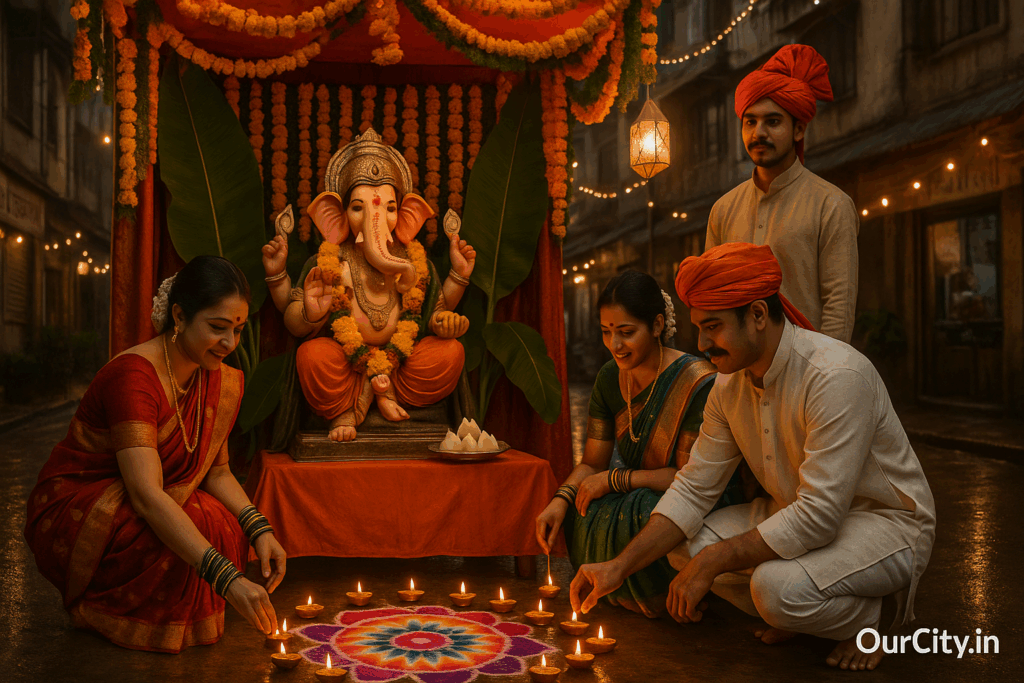
Ganeshotsav: The heart of Dombivli’s community feel. Pandal clusters in Ramnagar, MIDC lanes, Sonarpada, and Phadke Road host aarti (morning/evening). Visarjan days lead to diversions near Durgadi/Ulhas ghats and Shahad. Eco-idols (शाडू माती) are popular—good to encourage.
-
Onam (Kerala associations across Thakurli/Dombivli): Pookkalam (flower rangoli) and sadya lunches in halls—book slots early.
October
-
Navratri: Garba/ghat aarti in Khadakpada, Ramnagar, Kolegaon halls. Durgadi Devi temple fair draws big crowds; reach before 06:00 for calmer darshan.
-
Dussehra: Shami puja; smaller effigy burnings may happen in open grounds—stand downwind.
November
-
Diwali: Early morning abhyangasnan, temple visits, and evening faral exchanges. Kandils light up Tilak Road balconies. Fireworks rules shift year by year—follow police advisories.
-
Guruparab: Gurdwaras in Dombivli/Kalyan host kirtan and langar; cover head, sit in pangat rows.
December
-
Christmas: Midnight mass in parish churches (Dombivli East/West); arrive by 23:15. Dress modest, carry a light layer—post-midnight gets breezy (18–20 °C).
-
New Year: Community bhajans and quiet vigil options also exist, not just parties; return home by cab if late.
Where to Go & When to Arrive (Time Cues)
-
First aarti windows: 05:45–07:15 (temples); queues are gentlest.
-
Evening surge: 18:00–20:00 (all faith spaces). For kids/elders, aim 16:30–17:30.
-
Visarjan viewing: secure spot 45–60 min early at Ulhas-side ghats near Durgadi/Shahad; keep exit lane behind you.
-
Garba: Many societies allow visitors until 22:00–22:30 on weekdays; check society noticeboards for guest passes.
Family-, Senior-, and Child-Friendly Tips
-
Pick shaded sides of lanes; carry earplugs for toddlers at Dahi Handi/Garba speakers.
-
Stroller-friendly: inside large halls (Pendharkar College auditorium events) rather than street corners.
-
Seniors: Use foot-overbridges at Kalyan/Dombivli stations and take KDMT buses to chowks rather than long walks on festival days.
-
Set a meet-up point: “Tilak Chowk paudhe ke paas” (near the plant bed) or “FOB ke left staircase par”.
🪔 Sacred Spaces Etiquette (Temples • Gurdwaras • Dargahs/Mosques • Churches • Ghats)
Temples in Kalyan-Dombivli range from lane-side shrines to the hill-hugging Birla Mandir (Shahad) and the Durgadi Devi complex. Gurdwaras are community-run and warm. Mosques and small dargahs dot Bazar Peth and station lanes. Churches in Dombivli East/West keep clear signage on mass times. Ghats along the Ulhas and Waldhuni are active during visarjan and last rites—hold a respectful distance.
What to Wear & Carry
-
Dress codes: Cover shoulders/knees; breathable cottons in heat; a scarf/dupatta for head cover (women) and a small gamcha (men) helps in gurdwaras/dargahs.
-
Footwear: Slip-ons. Shoe racks fill up; tie laces together and tuck to side if racks overflow.
-
Carry: Small cloth bag for prasad/offerings, socks (hot floors), refillable bottle, handkerchief, wet wipes, a zip pouch for phones.
-
Fragrance: Keep light; closed sanctums can be sensitive.
Offerings/Prasad/Chadar: Ranges & Rules
-
Flowers: ₹20–₹100 (temple stalls).
-
Prasad boxes/laddoos/pedas: ₹20–₹60 per small packet.
-
Oil/ghee packs or diya sets: ₹50–₹200.
-
Chadar at dargahs: ₹200–₹600 (size/embroidery changes rate).
-
Candles at churches: ₹10–₹30 each.
Give/receive with your right hand, keep it simple, avoid flaunting notes. Digital UPI boxes are common; keep ₹10–₹50 change for hundi plates to keep the line moving.
Photography & Phone Etiquette
-
Ask first: “Photography allowed hai?” / “फोटोग्राफी अलाऊड है?” (Photography allowed hai?)
-
No flash inside sanctums.
-
During aarti, don’t raise phones above shoulders; focus on the ritual, not the reel.
-
At ghats/cremations, no photos—step back, give silence.
Ask Politely (Ready Scripts)
-
“Queue kahan se shuru hoti hai?” (क्यू कहाँ से शुरू होती है?) — Where does the queue start?
-
“Darshan token yahin milta hai?” (दर्शन टोकन यहीं मिलता है?) — Is the darshan token issued here?
-
“Head cover kahaan milega?” (हेड कवर कहाँ मिलेगा?) — Where can I get a head cover?
-
“Maaf kijiye, photo allowed nahi hai to main phone band kar deta/deti hoon.” (माफ़ कीजिए, फोटो अलाउड नहीं है तो मैं फोन बंद कर देता/देती हूँ।) — Sorry, if photos aren’t allowed I’ll put my phone away.
-
“Langar kahaan serve ho raha hai? Main seva kar sakta/sakti hoon?” (लंगर कहाँ सर्व हो रहा है? मैं सेवा कर सकता/सकती हूँ?) — Where is langar served? Can I volunteer?
🪔 Processions, Melas & Community Events
Kalyan-Dombivli runs on participation. Ganeshotsav visarjan lines slip past Durgadi; Navratri nights pulse in Ramnagar and Khadakpada halls; Muharram tazias keep a slow, dignified pace near old lanes; Christmas choirs line up outside parish churches.
Safe Viewing Spots & Exit Plans
-
Stand at barricade edges, not in road centers.
-
Keep a clear line to a side lane—e.g., from Tilak Road corner, plan to step into the parallel galli if the crowd swells.
-
For kids/elders, use raised plinths outside closed shops (with owner’s nod) rather than manholes/median blocks.
Transport Diversions & Crowd Windows
-
Expect route changes near Durgadi, Shahad, Patri Pul, Bazar Peth on visarjan/Navratri nights.
-
Rickshaw minimums trend ₹30–₹40; festival nights may add ₹10–₹20 informally—confirm before boarding.
-
KDMT buses add trips on big nights—carry small change and a card wallet.
-
Trains: If returning after 22:30, choose compartments that are reasonably crowded; if too empty, wait for the next one. For groups, sit together near the door but don’t block it.
If You Get Separated (Meet-up Scripts)
-
“Main Tilak Chowk ke signal ke paas wait kar raha/rahi hoon.” — I’m waiting near the Tilak Chowk signal.
-
“FOB ka left staircase, station board ke niche.” — At the left staircase of the foot-overbridge, under the station board.
-
Write one contact number on paper tucked in a kid’s pocket.
🪔 Seva, Daan & Doing Your Bit
Simple Ways to Volunteer
-
Shoe-rack help at temples in Rambaug, Manpada.
-
Langar service at gurdwaras: wash hands, cover head, join pangat; serve small portions, offer seconds if requested.
-
Queue management: Ask trustees/security before assisting.
-
Post-event cleanups: After visarjan or garba nights, join local youth groups—bring gloves.
Hygiene & Clean-up Etiquette
-
Carry a spare garbage bag for your own cups/plates/flowers.
-
Use designated bins; don’t throw flowers or coins into water bodies.
-
If barefoot after a ritual, watch for wet tiles and petals—walk slow.
Digital UPI vs Cash (When & How)
-
UPI keeps lines moving at busy hundis; scan, pay, step aside for receipt.
-
Small vendors for flowers/camphor may prefer cash; keep ₹10/₹20 notes.
-
Avoid filming your daan—quiet giving is valued.
🪔 Arts, Crafts, Music & Dance of Kalyan-Dombivli
This twin city loves its Marathi theatre, kirtan, and community dance.
-
What locals watch: Musical plays and bhajan sandhyas at sabha halls in Tilak Chowk, Khadakpada, and college auditoriums around Pendharkar College.
-
Where idols come from: MIDC (Phase II) lanes and small workshops in Sonarpada/Ramnagar turn out eco-friendly Ganesh murtis—visit in August mornings to avoid paint fumes and crowds.
-
Dance & music: Garba workshops pop up each September. Waari-style abhang evenings appear near Bazar Peth and society lawns.
-
Ethical buying: Prefer shadhu maati (clay) idols, hand-rolled wicks, and locally woven puja textiles. Ask the artisan: “Yeh handmade hai ya mould-cast?”
-
Nearby heritage: If you have a half-day, Haji Malang (Malanggad) near Kalyan East is a shared-faith pilgrimage up a hillside—go in groups, wear grippy footwear, keep voices low near the dargah.
🪔 Language, Greetings & Everyday Manners
Local Phrases (Transliteration + Script)
-
Namaskar / नमस्कार, Pranam / प्रणाम, Sat Sri Akal / सत श्री अकाल, Adaab / आदाब.
-
“Darshan mein kitna samay lagega?” (दर्शन में कितना समय लगेगा?) — How long will darshan take?
-
“Line kidhar ban rahi hai?” (लाइन किधर बन रही है?) — Where is the line forming?
-
“Dhanyavaad, main line mein hoon.” (धन्यवाद, मैं लाइन में हूँ।) — Thanks, I’m already in the queue.
Right-Hand Giving, Thresholds, Sacred Trees/Animals
-
Use right hand to give/receive.
-
Don’t step on thresholds; pause, touch lightly, and enter.
-
Respect peepal and banyan trees with threads/ties; don’t pull at them.
-
Don’t touch idols; fold hands a little away.
What Not to Do (Short List)
-
Don’t climb on vehicles/shrines/statues for photos.
-
No drones around processions or sacred spaces.
-
Avoid loud arguments near ritual leaders or during sermon/kirtan/namaz.
🪔 Attire, Comfort & Accessibility
Dress: Light cottons; dupatta/scarf for head; avoid tight or noisy jewellery in quiet spaces.
Carry list: Small scarf, socks, bottle, hanky, wipes, cloth bag, minor first-aid (band-aid/ORS).
Accessibility: Many local shrines have steps and narrow entries; check the trust noticeboard/app for ramps. Quieter slots: 06:15–06:45 (temples), post-mass 08:00 (churches), between prayers (mosques).
Sensory-friendly: Keep earplugs; stand away from speakers at Dahi Handi/garba; prefer afternoon rehearsals over peak shows.
🪔 Seasonal Playbooks (Heat • Monsoon • Winter/Smog • Peak Festive)
Summer (Apr–Jun)
-
Book earliest darshan. Carry ORS; floors get hot—socks help.
-
Use shaded lanes: e.g., inner gallis of Ramnagar over sun-baked corners of Tilak Road at noon.
Monsoon (Jun–Sep)
-
Non-slip footwear; plastic covers for flowers/prasad.
-
Watch for waterlogging at low dips around Patri Pul and lane junctions; give way to processions.
-
Keep a foldable poncho; umbrellas poke—mind the crowd.
Winter/Smog (Nov–Jan)
-
Early aarti needs a light layer; consider a mask (N95/FFP2) near fireworks or dust.
-
Warm water flask for elders helps during long queues.
Peak Festive Weeks
-
Pre-load your metro/travel card (for trains/buses).
-
Identify quiet hours: temples pre-7:00, garba Sundays 17:00–18:30 family slots, markets post-21:00.
-
When not to bring small kids: visarjan nights after 21:00 near Durgadi/Shahad ghats.
Exam & Job-Hunt Season
-
For calm prayer/study, try mid-week mornings at smaller lane temples in Kolegaon, church lawns in Dombivli West, or library corners near Pendharkar College.
🪔 Quick Cheatsheets (Tables)
Festival Months vs Typical Timings
| Festival | Typical Month(s) | Gentler Slot | Surge Window |
|---|---|---|---|
| Makar Sankranti | Jan | 07:00–09:00 temple visits | 18:00–20:00 |
| Mahashivratri | Feb/Mar | 05:45–07:30 | 19:00–23:00 |
| Holi/Rangpanchami | Mar | 08:00–10:00 (dry colours) | 11:00–14:00 |
| Ramzan/Iftar | Varies | 12:00–16:00 (prep) | Sunset + 60–90 min |
| Gudi Padwa | Mar/Apr | 06:30–08:30 | 09:00–11:00 yatras |
| Dahi Handi | Aug | 16:00–18:00 | 18:00–20:30 |
| Ganeshotsav | Aug/Sep | 06:00–09:00 | 18:00–21:00 |
| Navratri | Sep/Oct | 17:00–18:30 (family) | 20:00–22:30 |
| Diwali | Oct/Nov | 06:00–09:00 | 18:00–21:00 |
| Christmas | Dec | 18:00–20:00 | 23:30–00:30 |
Etiquette by Place of Worship
| Place | Footwear | Head Cover | Offering Tips | Phone/Photo |
|---|---|---|---|---|
| Temple | Off at rack | Optional (women often carry dupatta) | Flowers/prasad; right hand | Ask; no flash; phones down at aarti |
| Gurdwara | Off at jora ghar | Mandatory (scarves provided) | Karah prasad is offered—don’t refuse rudely | Photos only outside/main hall with permission |
| Dargah/Mosque | Off before entry | Recommended at dargah; modest wear | Chadar/flowers; be discreet | Avoid during namaz; ask at dargah |
| Church | Usually allowed in courtyard, off not required unless signposted | Not required | Candles/donations in box | No photos during mass without permission |
| Ghats | Keep footwear on unless ritual requires | Not applicable | Don’t throw coins/flowers into water | No photos of last rites/immersions close-up |
Offering/Donation Ranges (₹)
| Item | Typical Range |
|---|---|
| Flowers/garlands | ₹20–₹100 |
| Prasad packets | ₹20–₹60 |
| Oil/Ghee/Camphor | ₹50–₹200 |
| Chadar (dargah) | ₹200–₹600 |
| Candles (church) | ₹10–₹30 |
| Water/Chai near venues | ₹10–₹25 |
| Vada pav/Misal outside | ₹20–₹60 |
| Short rickshaw hops (2–3 km)* | ₹40–₹80 |
*Fares vary—confirm before starting.
Quiet-Hour Windows & Crowd Surges
| Space | Quiet Window | Surge Window |
|---|---|---|
| Lane Temples (Ramnagar/Kolegaon) | 06:15–06:45 / 14:30–16:00 | 18:00–20:00 |
| Durgadi/Big Complexes | 05:45–06:15 | 19:00–21:00 |
| Gurdwaras (Langar days) | 12:00–13:00 setup | 13:00–15:00 |
| Mosques (Fri/Jumu’ah) | Post-Asr | Pre-Khutbah to Namaaz |
| Churches (Sun) | Post-mass 08:00–09:00 | 06:30–07:30 & 18:00–19:30 |
| Ghats (Visarjan) | Non-event mornings | Sunset to late night on main days |
🪔 FAQs (Real Questions, Short Answers)
1) Can I wear jeans to temples/garba?
Yes, if modest (no rips/short shorts). Add a dupatta/scarf for shrines.
2) Are photos okay during aarti?
Only if allowed; keep phones low, no flash. If unsure: “Photography allowed hai?”
3) Cash or UPI for donations?
Both work. Keep small notes for quick hundi offerings; UPI boxes speed things up.
4) What time should I reach for visarjan viewing?
45–60 minutes early near Durgadi/Shahad ghats; keep an exit route and avoid barricade openings.
5) Is solo-female participation safe at night events?
Stick to lit, crowded spots; leave by app cab if late. Share live location with a friend.
6) Can I join langar if I’m not Sikh?
Yes. Cover head, wash hands, sit in pangat, don’t waste food.
7) Are drones allowed for festival shots?
No—authorities often restrict them near processions and sacred spaces.
8) How do I refuse prasad if I’m fasting?
“Abhi vrat hai; main prasad ko matha tekta/tektee hoon. Dhanyavaad.” — I’m fasting; I offer my respect to the prasad. Thank you.
9) What about toddlers at loud events?
Carry earplugs; prefer 16:30–17:30 slots for garba/pandals; avoid late visarjan nights.
10) Where do I ask about tokens/queues?
Look for the seva desk or a volunteer with a badge: “Queue kahan se shuru hoti hai?”
11) Can I take flowers inside dargahs and churches?
Yes at dargahs (often chadar/flowers); churches usually prefer candles/donation boxes—check signs.
12) What footwear near ghats?
Closed sandals with grip; avoid heels. Keep distance from the edge; follow marshals.
13) What’s the polite way to handle crowd push?
“Aram se, line mein hoon. Dhakka mat dijiye please.” — Easy, I’m in the line. Please don’t push.
14) Are there women-only queues?
Often at larger temples/mosques on peak days—check the signboards/volunteers.
15) How to get home late from Khadakpada/Manpada?
Use app cabs from a lit main road, or go to Kalyan/Dombivli station as a group and take a reasonably busy train compartment.
🪔 Wrap-Up: You’ll Fit Right In
Kalyan-Dombivli rewards simple courtesies: greet warmly, keep your phone pocketed during the sacred bit, give with the right hand, stand where you’re not blocking someone’s darshan. Reach early for aarti, pick family windows for kids, and follow the volunteers—they make the city’s festivals run. If you’re unsure, just ask:
-
“Photography allowed hai?”
-
“Darshan token yahin milta hai?”
-
“Line kidhar ban rahi hai?”
You’ll hear helpful directions, often with a smile. That’s the local way in Rambaug, Phadke Road, Manpada, Sonarpada, Khadakpada, Thakurli, Shahad, and every galli between. Show up right, and the city opens its doors.