Jaipur Culture Guide
Table of Contents
Jaipur Traditions & Culture: Show Up Right
Pink city, bright marigolds, temple bells at dawn. Jaipur moves to a gentle but sure rhythm—Govind Dev Ji’s aarti inside the old City Palace courtyard, kites filling the sky on Makar Sankranti, qawwali evenings at small dargahs, Sunday mass near MI Road, and folk beats at Jawahar Kala Kendra (JLN Marg). Locals know when to arrive, what to carry, and how to ask politely. First-timers usually get two things wrong: timing and tiny courtesies. This guide fixes both—so you can join in, not just watch.
Expect practical notes from the places people actually go: Govind Dev Ji (Jaleb Chowk), Moti Dungri Ganesh, Birla Mandir (Laxmi Narayan), Khole Ke Hanuman Ji (Laxman Dungri), Galtaji (Monkey Temple, Galta Ji), Akshardham (Vaishali Nagar), small gurdwaras in Raja Park and Durgapura, dargahs tucked inside the walled city near Tripolia–Kishanpole stretch, and churches around C-Scheme and MI Road. We’ll also point you to quieter corners like Ram Niwas Garden edges, Jawahar Circle lawns (Malviya Nagar), and the courtyards around Nahargarh foothills.
🪔 Why This Culture Guide Works for Jaipur
Here’s the thing: Jaipur’s calendar is full, but the real art is in the micro: reaching by 05:45 for a cool-floor aarti in May, keeping a scarf for sudden head-cover needs, or knowing that the 18:00–20:00 window near Ajmeri Gate chokes up during festive days. This guide gives you:
-
Clarity on when to go and what changes with season.
-
Scripts in simple Hinglish with Devanagari so you can ask without awkwardness.
-
Safety & access tips: crowd pockets, exits, senior-friendly detours.
-
Respect cues: prasad (प्रसाद) handling, aarti (आरती) behaviour, chadar (चादर) etiquette, langar (लंगर) basics, and quiet around rites.
You’ll see neighborhood name-drops—Johari Bazaar, Bapu Bazaar, Chandpole, Amer, Vaishali Nagar, Mansarovar, C-Scheme, Raja Park, Malviya Nagar, Sanganer, Bagru, MI Road, Ramganj, and more—so it feels local, not generic.
🪔 Festival Calendar: What Happens When (Jan–Dec)
City Highlights Month by Month
January
-
Makar Sankranti (14 Jan): Jaipur’s sky war. Head to Kishanpole–Chandpole rooftops, Raja Park, and Bapu Bazaar lanes. Wear shoes with grip; glass-coated manjha in gutters—watch your step. Morning wind is gentler; evenings are stunning.
-
Lohri (eve of Sankranti): Small bonfires in Vaishali Nagar and Mansarovar parks. Offer til-gud, groundnuts.
-
Sunday masses steady near MI Road and C-Scheme; reach 10–15 mins early.
February
-
Basant Panchami: Yellow attire, Saraswati puja in schools and small community corners across Adarsh Nagar and Shastri Nagar.
-
Jaipur Literature Festival (culture, not ritual): lawns packed near Rambagh/JLN Marg; expect traffic near Tonk Road.
March
-
Mahashivratri: Queues at Galtaji and Khole Ke Hanuman Ji (Shiv temples nearby). Carry water and socks for hot/cold floors.
-
Holi: Family-first morning colours in C-Scheme and Vaishali Nagar parks; temple rang (रंग) events around Govind Dev Ji precincts. Keep phones sealed; respect those who signal “No colour”.
April
-
Gangaur (Mar/Apr): Women carry isar–gangaur idols; processions around Tripolia–Chhoti Chaupar. Lovely to watch near barricades—don’t block dancers.
-
Ram Navami: Temples like Moti Dungri busy; reach before 07:00.
May–June (Summer Quiet, but Early Aartis Shine)
-
Lean weeks for big festivals; perfect time for pre-dawn darshan at Birla Mandir and Govind Dev Ji. Start at 05:30–06:00 while the stone is cool.
July–August
-
Teej: Monsoon welcome, women-centered processions from City Palace side toward Tripolia Gate. Best view: edges near Sireh Deori (Hawa Mahal side) but keep exits clear.
-
Muharram (moving dates): Tazias move through the walled city; be quiet, observe from side lanes. No intrusive photos.
September
-
Janmashtami: Govind Dev Ji is the heart. Crowds surge post 18:00; the mangala aarti is sublime pre-dawn.
-
Ganesh Chaturthi: Moti Dungri Ganesh draws day-long lines; bring compact offerings only.
October–November
-
Navratri/Dussehra: Garba/dandiya at community halls in Mansarovar, Raja Park, Vaishali Nagar; Ramlila grounds in Adarsh Nagar.
-
Diwali: Walled city lights—Johari Bazaar, Tripolia, Bapu Bazaar, MI Road sparkle. Lakshmi puja at homes/shops; Birla Mandir looks magical—arrive by 17:30 to skip 19:00 crush.
-
Guruparab (moving): Gurdwaras in Raja Park and Durgapura serve langar; cover head, sit in pangat (row) and eat mindfully.
December
-
Christmas: Midnight mass near MI Road/C-Scheme churches—quiet entry, simple greetings.
-
New Year: Many prefer a family aarti at Birla Mandir or a quiet thanks-giving at Akshardham.
Locals say… “Reach before sunrise at Amer or Galtaji—the hills make the bhajans feel softer.”
Where to Go & When to Arrive (Time Cues)
-
Govind Dev Ji (City Palace/Jaleb Chowk): Pre-dawn mangala aarti changes with season. Safe cue: reach by 05:45–06:00 (summer), 06:15–06:30 (winter). Evenings crowd 18:00–20:00; consider 16:30–17:30 for a quieter window.
-
Moti Dungri Ganesh: Lines start early on Tuesdays and festival days. Arrive by 07:00; avoid 18:00–20:00.
-
Birla Mandir (Laxmi Narayan): Best at sunrise/sunset. Carry a light shawl for shoulders.
-
Galtaji (Monkey Temple): Morning is peaceful; carry a scarf to deter monkeys; keep food sealed.
-
Khole Ke Hanuman Ji: Hill temple; a bit of a climb. Morning shade helps; carry water, cap.
-
Gurdwaras (Raja Park/Durgapura/Mansarovar): Langar usually late morning–afternoon on big days.
-
Dargahs/Masjids (walled city belts like Ramganj–Tripolia side): Evenings post-maghrib see devotees; Friday busy. Be discreet; ask before photos.
-
Churches (MI Road/C-Scheme): Sundays—reach 10–15 mins early to settle in quietly.
First/last-mile tips: Jaipur Metro (Pink & Orange lines) helps around Chandpole–Badi Chaupar; for old city, last 800–1,200 m is often by foot or e-rickshaw. E-rickshaw short hops ₹15–40; autos within the walled city ₹80–150 depending on traffic.
Family-, Senior-, and Child-Friendly Tips
-
Viewing pockets: The fence line along Ram Niwas Garden side streets during processions; Jawahar Circle lawns for festival picnics; the broad footpath near Albert Hall is stroller friendly (avoid center lawns at night).
-
Meet-up plan: Fix a visible landmark—Hawa Mahal corner, Ajmeri Gate clock side, or Badi Chaupar metro exit. Write a contact number and tuck in a child’s pocket.
-
Quiet corners: Small shrines in C-Scheme and Vaishali Nagar stay calm outside peak aarti; Akshardham has orderly queues.
🪔 Sacred Spaces Etiquette (Temples • Gurdwaras • Dargahs/Mosques • Churches • Ghats)
What to Wear & Carry
-
Dress codes: Covered shoulders/knees. Light cottons April–Sept; a warm layer Dec–Jan pre-dawn.
-
Footwear: Slip-ons. Floors get scorching in May–June; carry socks.
-
Carry list: Small scarf/dupatta (head cover), refillable bottle, handkerchief, wet wipes, compact cloth bag for offerings, low-noise phone mode.
-
Jewellery/phones: Keep minimal and secure, especially in dense lanes of Johari Bazaar or Tripolia.
Offerings/Prasad/Chadar: Ranges & Rules
-
Flowers: ₹20–100; choose fresh, unstrung marigold/rose.
-
Prasad (लड्डू/पेड़ा): ₹20–60 for small boxes near temples; avoid opening near monkeys at Galtaji.
-
Oil/ghee packs: ₹50–200 for diya/abhishek counters.
-
Chadar at dargah: ₹200–600; keep folded respectfully; remove plastic before offering.
-
Candles/incense: ₹10–30; use designated stands only.
Daan/Hundi etiquette: Give with right hand; don’t fan out cash. UPI boxes are common; check official temple/dargah QR before scanning. Keep ₹10/₹20 notes for quick flow.
Photography & Phone Etiquette
-
Aarti time: Don’t raise phones above shoulder; flames move—stay steady and do not block.
-
No-photo zones: Some sanctums ban photos; always ask.
-
Faces during rites: Avoid. No drones near processions or forts without permission (legal issue + safety).
-
If told no: “Maaf kijiye, photo allowed nahi hai to main phone band kar deta/deti hoon.”
Ask Politely (Ready Scripts)
-
“Photography allowed hai? / फोटोग्राफी अलाउड है?”
-
“Queue kahan se shuru hoti hai? / क्यू कहाँ से शुरू होती है?”
-
“Darshan token yahin milta hai? / दर्शन टोकन यहीं मिलता है?”
-
“Head cover kahaan milega? / हेड कवर कहाँ मिलेगा?”
-
“Langar kahaan serve ho raha hai? Main seva kar sakta/sakti hoon?”
-
“Line kidhar ban rahi hai? / लाइन किधर बन रही है?”
-
“Darshan mein kitna samay lagega? / दर्शन में कितना समय लगेगा?”
🪔 Processions, Melas & Community Events
Safe Viewing Spots & Exit Plans
-
Edges over center: Stand along barricades near Sireh Deori, Chhoti Chaupar, or side lanes off Bapu Bazaar. Don’t crowd performers.
-
Exits: Pre-identify a side street toward MI Road or Ajmeri Gate; avoid dead ends of Kishanpole during surges.
-
Children/elders: Keep a light scarf for dust, small earplugs for drums. Carry ORS in summer.
Transport Diversions & Crowd Windows
-
Diversions: On big days (Teej, Diwali week), old city gates—Ajmeri, Sanganeri, Chandpole, Tripolia—see closures. Park outside and walk.
-
Crowd windows to avoid: 18:00–20:00 near major temples and main bazaars.
-
Better windows: 05:45–07:30 (summer), 06:30–08:00 (winter) for darshan; 15:00–17:00 for browsing Johari/Bapu without elbowing.
If You Get Separated (Meet-up Scripts)
-
“Main Badi Chaupar metro ke gate pe ruk raha/rahi hoon. Aap idhar aao.”
-
“WhatsApp location bhej diya; aap Ajmeri Gate wali side pakdo.”
-
“Police volunteer ko bolo—hum log Hawa Mahal ke corner pe milte hain.”
🪔 Seva, Daan & Doing Your Bit
Simple Ways to Volunteer
-
Shoe-rack help at big temples (ask the volunteer desk).
-
Langar service at gurdwaras: wash hands, cover head, sit or serve as directed.
-
Queue management: follow lead volunteers; don’t shout—use hand cues.
-
Post-event cleanup: join brooms/garbage bag teams at Raja Park community events or after Teej processions.
How to offer: “Main seva karna chahta/chahti hoon—kahan help chahiye?”
Hygiene & Clean-up Etiquette
-
Carry a small trash bag; pack your own waste.
-
Use temple bins; don’t toss flowers/camphor in open drains.
-
Avoid feeding monkeys; it worsens aggression near Galtaji.
Digital UPI vs Cash (When & How)
-
UPI: Use only official QR at temple trusts/dargahs; verify the name before paying.
-
Cash: Keep small notes for hundi/daan bowls; no showy bundles.
-
Receipts: For larger donations, request a receipt from the trust counter.
🪔 Arts, Crafts, Music & Dance of Jaipur
What to See Live (Rehearsals, Sabhas, Baithaks)
-
Jawahar Kala Kendra (JLN Marg): Evening baithaks, folk nights, exhibitions; check their noticeboard for Kathak (Jaipur gharana) and Maand recitals.
-
Ravindra Manch (Ram Niwas Garden): Community theatre, folk troupes.
-
Amer Fort courtyards: Occasional classical/fusion evenings—arrive early for seating.
-
Neighborhood festivals: Bagru and Sanganer craft mohallas sometimes host open-courtyard demos—ask politely, don’t block work areas.
Locals say… “In Bagru, let the artisan finish a block—then ask questions.”
Ethical Souvenir Buying (Quick Tests & GI Mentions)
-
Blue Pottery (GI): Look for slight glaze variation; too-perfect identical pieces suggest mass moulds.
-
Sanganeri/Bagru prints (GI belts): Hand-block shows tiny inconsistencies; backside should hold some dye.
-
Leheriya/Bandhej: Tie-dye edges are soft; printed imitation looks flat.
-
Kundan-Meenakari: Ask for silver/gold base declaration; GST bill and hallmark where applicable.
-
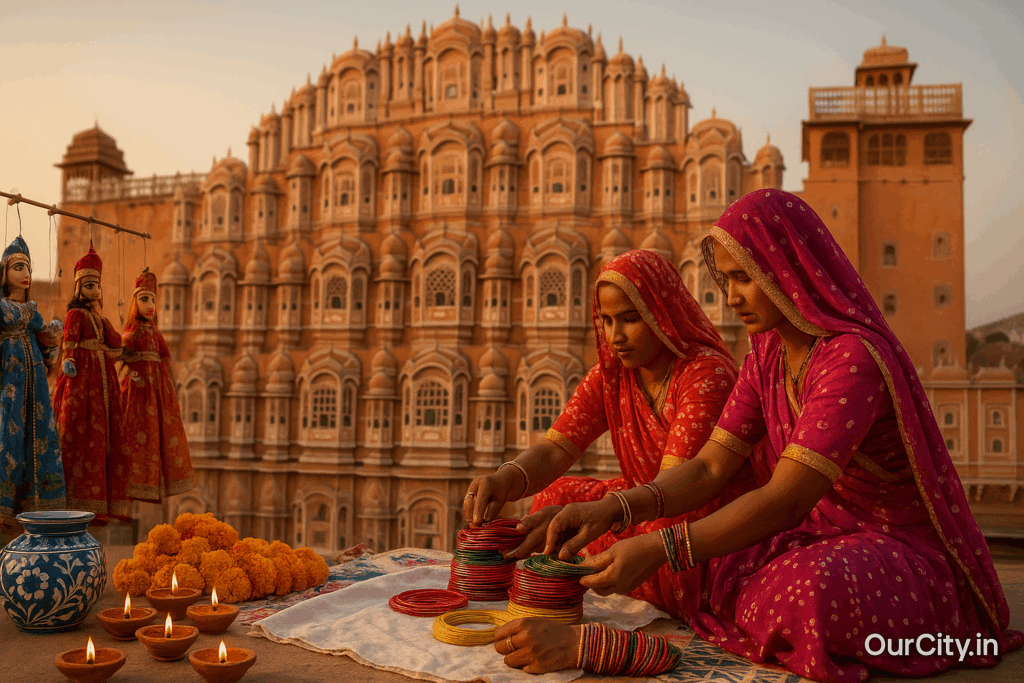
Lac bangles (Maniharon ka Rasta near Johari Bazaar): Heat-work stalls—keep distance from flames.
Pay fair, don’t haggle to insult. If in doubt, buy from state emporiums or known craft clusters in Bapu Bazaar, MI Road showrooms, or JKK fairs.
🪔 Language, Greetings & Everyday Manners
Local Phrases (Transliteration + Script)
-
“Khamma Ghani” (खम्मा घणी) / “Ram Ram sa” (राम राम सा) — respectful Rajasthani greetings.
-
“Namaste” (नमस्ते), “Pranam” (प्रणाम).
-
“Sat Sri Akal” (ਸਤਿ ਸ੍ਰੀ ਅਕਾਲ) in gurdwaras; “Adaab” (अदाब) near dargahs/mosques.
-
“Dhanyavaad, main line mein hoon.” (धन्यवाद, मैं लाइन में हूँ)
-
“Maaf kijiye, bheed zyada hai—baad mein aata/ati hoon.” (माफ कीजिए, भीड़ ज़्यादा है—बाद में आता/आती हूँ)
Right-Hand Giving, Thresholds, Sacred Trees/Animals
-
Give/receive with the right hand or both hands together.
-
Don’t step on thresholds; don’t touch idols unless permitted.
-
Respect sacred trees: peepal (पीपल)/banyan (बरगद) often have shrines.
-
Be calm around cows and dogs in Tripolia/Ramganj lanes; don’t tease monkeys at Galtaji.
What Not to Do (Short List)
-
Don’t climb vehicles/shrines/statues for photos.
-
No loud arguments near ritual leaders.
-
No flying drones near forts/processions.
-
Don’t throw coins/flowers in stepwells or lakes; use bins.
🪔 Seasonal Playbooks (Heat • Monsoon • Winter/Smog • Peak Festive)
What Changes, What to Pack, When to Go
Summer (Apr–Jun, 38–45 °C):
-
Go early: first aarti 05:45–07:00.
-
Pack: cap, ORS sachet, sunglasses, socks for hot floors, light scarf.
-
Travel: Prefer metro + short e-rickshaw over long noon walks.
-
Food: Lime water, chaach from trusted shops—₹20–40. Avoid open cut fruit.
Monsoon (Jul–Sep):
-
Footwear: Non-slip sandals.
-
Carry: Plastic cover for offerings, quick-dry dupatta.
-
Routes: Old city puddles near Bapu Bazaar cross-lanes; watch for slippery stone near Hawa Mahal.
-
Pandals: Prefer covered pandals; don’t block drains.
Winter/Smog (Dec–Jan, nights 8–10 °C):
-
Layer: Shawl for pre-dawn darshan.
-
Mask: N95/FFP2 on hazy nights along MI Road/Tonk Road.
-
Warm snacks: Tea ₹10–20, kachori ₹20–35—crowd magnets near Bapu Bazaar; keep distance from hot oil carts.
Peak Festive Weeks:
-
Plan transport: Recharge metro card earlier in the week.
-
Quiet hours: 15:00–17:00 temple visits; 13:00–16:00 market runs.
-
Kids: Avoid 18:00–20:00 surge. Use app cabs at night; skip random lifts.
Exam & Job-Hunt Season (Mar–Apr, Oct–Nov):
-
Calm pockets: Church lawns near C-Scheme on weekdays, side courtyards at Birla Mandir, reading corners at JKK.
-
Small prayer stops: Neighborhood temples in Vaishali Nagar/Mansarovar are steady and quiet midday.
🪔 Quick Cheatsheets (Tables)
Festival Months vs Typical Timings
| Festival/Utsav | Typical Month(s) | Time cues (Jaipur) |
|---|---|---|
| Makar Sankranti (Kites) | Jan | Rooftops all day; best wind 16:00–18:00 |
| Mahashivratri | Feb/Mar | Early darshan; avoid 18:00–20:00 |
| Holi | Mar | Family morning; temple rang late morning |
| Gangaur | Mar/Apr | Processions late afternoon–evening |
| Ram Navami | Mar/Apr | Pre-10:00 darshan best |
| Teej | Jul/Aug | Processions 16:00 onward |
| Muharram | Jul–Sep (moves) | Evenings; be discreet |
| Janmashtami | Aug/Sep | Mangala aarti pre-dawn, crowds in evening |
| Ganesh Chaturthi | Aug/Sep | All-day queues at Moti Dungri |
| Navratri/Dussehra | Sep/Oct | Garba nights 20:00–23:00 |
| Diwali | Oct/Nov | Temple 17:30–19:00 peak; markets late |
| Guruparab | Oct/Nov (moves) | Day langar; cover head |
| Christmas | Dec | Midnight mass; quiet entry |
Live timings vary; check the temple trust’s app/noticeboard or city police advisory on event days.
Etiquette by Place of Worship
| Place | Footwear | Head Cover | Queue/Token | Prasad/Offerings | Photos |
|---|---|---|---|---|---|
| Temples (Govind Dev Ji, Birla, Moti Dungri) | Leave at rack; carry receipt token if any | Optional; scarf welcome | Some have counters | Small prasad, flowers fine | Often outside sanctum; ask |
| Gurdwaras (Raja Park, Durgapura) | Leave at jora ghar | Required (scarf/patka) | Walk straight to hall | Karah prasad served; don’t waste | No photos during ardas |
| Dargahs/Mosques (walled city) | Outside | Required (scarf/cap) | Follow gendered lines | Chadar/flowers; be modest | Discreet; often discouraged |
| Churches (MI Road/C-Scheme) | Keep tidy; soft soles | Not required | Find a pew quietly | No food; monetary offering optional | Avoid flash; ask before |
Offering/Donation Ranges (₹)
| Item | Typical ₹ | Notes |
|---|---|---|
| Flowers | 20–100 | Fresh, simple |
| Prasad box | 20–60 | Keep sealed till after darshan |
| Oil/Ghee pack | 50–200 | Use designated diya stands |
| Chadar (dargah) | 200–600 | Remove plastic, fold respectfully |
| Candles/Incense | 10–30 | Use stands; don’t litter wax |
Quiet-Hour Windows & Crowd Surges
| Venue | Quieter Window | Surge Window |
|---|---|---|
| Govind Dev Ji | 06:00–07:00, 15:30–17:00 | 18:00–20:00 |
| Moti Dungri Ganesh | 07:00–09:00 (non-Tues) | Tuesdays, 18:00–20:00 |
| Birla Mandir | Sunrise, 16:30–18:00 | Festival evenings |
| Galtaji | 07:00–09:00 | Weekends 10:00–12:00 |
| Old City Bazaars | 13:00–16:00 | 18:00–21:00 (festival week) |
🪔 FAQs (Real Questions, Short Answers)
1) What should I wear for temple visits in Jaipur?
Covered shoulders/knees, light cottons, slip-on footwear. Carry a scarf/dupatta; socks help on hot floors.
2) How early for aarti at Govind Dev Ji?
Summer: reach by ~05:45–06:00. Winter: ~06:15–06:30. Evenings are busy; try 16:30–17:30.
3) Is photography allowed inside sanctums?
Often no. Ask: “Photography allowed hai?” Keep phones low; no flash.
4) How to behave at a gurdwara langar?
Cover head, wash hands, sit in pangat, accept karah prasad with right hand, finish what you take, return utensils.
5) Dargah etiquette for first-timers?
Head cover, modest clothing, chadar/flowers optional, no loud talk. Be discreet with photos; avoid faces.
6) Can I use UPI for donations?
Yes—verify the official QR (temple/dargah trust name). Keep small notes for hundi bowls.
7) What about kids and elders during processions?
Stand at edges, near barricades. Fix a meet-up point like Badi Chaupar metro. Carry earplugs and water.
8) Solo woman at night—safe routes?
Prefer metro where possible and app cabs door-to-door. Stick to lit corridors—MI Road, C-Scheme, Tonk Road—avoid inner gullies late.
9) Where to see Teej without getting trapped?
Side lanes near Sireh Deori and Chhoti Chaupar. Keep to the edges; exits toward MI Road.
10) Are drones allowed near forts or processions?
Generally no. Permissions are strict; avoid drones in sacred/procession zones.
11) Can I carry food inside Galtaji?
Better not. Monkeys target open food. Keep prasad sealed till you exit.
12) What to say if someone tries to cut the queue?
“Dhanyavaad, main line mein hoon. Aap please peeche se aaiye.” Calm tone; call a volunteer if needed.
13) Any eco-friendly offering tips?
Loose flowers (no plastic), small ghee packs, no glitter. Use bins; don’t throw in water bodies or stepwells.
14) How much cash to carry?
₹200–500 in small notes plus UPI. Offerings typically ₹10–200; chadar ₹200–600.
15) Where can I catch live folk art?
Check Jawahar Kala Kendra and Ravindra Manch boards; seasonal fairs at Bapu Bazaar/MI Road lawns.
🪔 Wrap-Up: You’ll Fit Right In
Jaipur rewards those who arrive a little early, carry a small scarf, and ask softly. Keep your steps light in the old city—Johari Bazaar to Tripolia—and save your widest smile for the volunteers who keep the queues moving. One last insider tip: for a calm, heartfelt moment, catch the first light touching Birla Mandir marble, then walk to Ram Niwas Garden while the city wakes. Respect, small courtesies, and smart timing—that’s the Jaipur way.