Indore Survival Guide
Table of Contents
Indore Life Hacks & Survival Guide
Indore runs on rhythm: early office rush from Vijay Nagar and Ring Road, evening food trails at Sarafa and Chhappan, weekend shopping near Rajwada and TI/Phoenix malls, and students flooding Bhanwar Kuwa and Geeta Bhawan. Summers spike, monsoon dumps, and winter haze can surprise first-timers. Newcomers usually misjudge distances (Ring Road looks “near”), under-plan for rain bursts, and forget small scripts that save time and money. This guide gives you daily moves, local words, season kits, and safety habits—so you can settle fast and stay steady.
🧭 Why These Survival Hacks Matter in Indore
Day 1 you need simple, repeatable steps—how to commute, what to say to an auto, when to avoid certain junctions, where to refill water, and how to keep your phone and ID safe. By Week 4, you want smarter shortcuts—park-and-ride ideas near iBus BRTS, knowing which exit to take at busy stops like LIG Square, and how to route around waterlogging pockets after a cloudburst. You also learn what locals quietly do: share live location on app cabs at night, keep ₹300–500 as “rain cash,” and carry a tiny zip pouch with photocopies of ID.
This guide sticks to Indore realities (iBus BRTS, city buses, autos/e-rickshaws, lively bazaars, sudden rains), explains scripts to use, and offers calm, non-judgmental advice. Nothing fancy—just what actually works.
🚇 Move Smart Every Day
Metro/Train/Bus Basics
-
City spine: AB Road and Ring Road carry most office traffic. Corridors around Vijay Nagar, Palasia (Old & New), and MR-10 get dense during rush.
-
iBus BRTS: The iBus corridor runs along the main stretch with median stations, prepaid ticketing, and level boarding. Think of it as a fast lane for buses; doors open to platforms in the middle. Buy tickets at the station counters—short hops are usually ₹10–25. Keep small notes or UPI ready.
-
City buses (AICTSL): Blue/white buses fan out to Rau, Rajendra Nagar, Sudama Nagar, and Musakhedi. Conductors accept cash or UPI; fares for short rides are typically ₹10–30. Ask, “Bhaiya, Laxmibai Nagar side jayegi?” (Will this go towards Laxmibai Nagar?)
-
Local trains: For occasional intercity or suburban hops (e.g., Indore Junction BG, Laxmibai Nagar, Mhow/Dr. Ambedkar Nagar), keep a buffer—platform changes happen. Print or download the PDF ticket in your phone’s document locker.
Women-only spaces: On crowded city buses, conductors often reserve front rows for women and elders—follow posted signs and cues.
First/last departures: Timings shift by season and weekends. Treat published schedules as guides, not gospel. For the most accurate timings and routes, check the AICTSL/city bus official channels and BRTS station boards before you plan a new route.
Tickets & passes (typical patterns):
-
Single journey: ₹10–30 (short), ₹30–60 (longer).
-
Day pass (if running): ₹60–100 range.
-
Student monthly (varies): ask for required ID proof—college card usually works.
-
Digital: UPI widely accepted; keep ₹50–100 change for small booths or when QR is down.
Interchange logic that saves steps:
-
On iBus, choose the coach near the footbridge if you plan to exit for Palasia/LIG side; at larger stations, exits align with either side of AB Road—look for overhead maps.
-
For Indore Junction, if you’re heading to Rajwada/Chhappan, exit towards the auto/stand side (ask “Rajwada side nikalna hai”); the stand staff will point you to the shortest path.
Auto/Taxi Fair-Play (Scripts + Price Cues)
Indore autos and e-rickshaws are everywhere—great for last-mile.
Fairness cues (typical ranges):
-
Auto meter start: Ask for meter. If they refuse, local short hops often settle in ₹30–100 depending on distance/traffic.
-
Per km feel: Expect around ₹14–18/km equivalent for autos, ₹20–25/km for cabs in normal traffic. Airport runs carry a luggage/stand surcharge.
-
Airport (Devi Ahilya Bai Holkar) to Vijay Nagar/Nipania: Expect a pre-agreed fare or app cab; autos may quote ₹250–400 depending on hour and bags.
Polite scripts that work:
-
“Bhaiya, meter se chaliye.” (Please run by meter.)
-
“Fixed rate kitna? Receipt dena.” (If fixed, how much? Give a receipt.)
-
“Mujhe Vijay Nagar jana hai, left se nikaalna.” (I need to go to Vijay Nagar; take the left exit.)
-
“Main app se book kar raha/rahi hoon.” (I’ll book via app.)
Ride-hailing (app cabs):
-
Better at night or for 8+ km trips.
-
Always share trip with a friend/family member, and check number plate matches the app.
-
If surge bites (rain/late night), compare “Auto” vs “Mini” classes; sometimes autos surge less.
-
Use the app’s SOS—works citywide.
Trusted last-mile stands: Near Indore Junction, Rajwada, Chhappan Dukan, Khajrana, and Vijay Nagar Square you’ll find organised autos/e-rickshaws. Expect a small queue and posted boards.
Peak Hours & Platform Positions
-
Peak windows to avoid: 08:30–10:30 and 18:00–20:30, sharper on weekdays around Bengali Square, Palasia, Vijay Nagar, MR-10 and Airport Road.
-
Best spots: On iBus, stand closer to the exit-side doors (watch floor arrows). At crowded stations, rear coaches sometimes fill slower.
-
Quick exits: If you’re alighting at LIG Square, watch for platform-side displays; position yourself near the footbridge end to reach autos faster.
🕔 Commuter Cheat Codes
-
Interchange hacks: For Palasia ↔ Vijay Nagar, pick iBus coaches near the footbridge for quick crossovers; the middle of the coach aligns best with stairways at many median platforms.
-
Park-and-ride ideas: Leave two-wheeler at Niranjanpur, LIG Square, or Vijay Nagar parking pockets (ask attendants). Switch to iBus for AB Road congestion.
-
Rain-day reroutes: If Bengali Square chokes, route via MR-10 towards Nipania; from Rau side, consider Ring Road detours to avoid AB Road pooling.
-
“Arrive by” cues: For morning interviews near Super Corridor (TCS/Infosys zone), arrive by 09:00 to beat security queues and lights. For Rajwada shopping, arrive by 17:30 on weekdays.
-
Sample morning pattern (student belt): Bhanwar Kuwa → Geeta Bhawan → Palasia via city bus/iBus; hop an e-rickshaw for the last 1 km.
-
Sample evening pattern (office belt): Vijay Nagar → Khajrana → Old Palasia; break the trip into two short auto hops—cheaper and faster than one long stuck ride.
🌤 Weather Playbooks That Actually Work
Heatwave Kit & Day Plan (Apr–Jun)
Indore can hit 42–45°C. Plan like locals:
ORS rule: 1 sachet per 1 L water. Mix one in the morning bottle; carry a second plain litre.
Refill-friendly stops: Phoenix Citadel, C21, TI Mall, big offices on Super Corridor, and co-working spaces near Nipania/Palasia. Many have water counters—carry a clean bottle.
Shade & clothing: Loose cotton/linen, light colours, cap/UV umbrella, breathable shoes. Cooling scarf helps during noon runs.
Warning signs: Cramps, dizziness, hot dry skin. Move to shade/AC, sip ORS slowly, wet towel on neck/armpits, and see a hospital if confusion persists.
Heat Day Plan (example):
-
06:30–09:30: Commute, outdoor errands.
-
11:30–16:00: Indoor work; avoid rides unless urgent.
-
16:30–19:00: Second shift of errands; pre-chilled water bottle.
-
Cooldown points: Step into Phoenix Citadel or C21 atriums for 10 minutes if you feel cooked.
Home heat kit (micro-checklist):
-
ORS 10–20 sachets
-
2× 1L bottles
-
Light towel for wet compress
-
Electrolyte tabs (backup)
-
Battery fan/USB fan (power cut days)
Monsoon Kit, Routes & Food Safety (Jun–Sep, sometimes Oct)
Footwear: Quick-dry sandals with grip; avoid smooth soles.
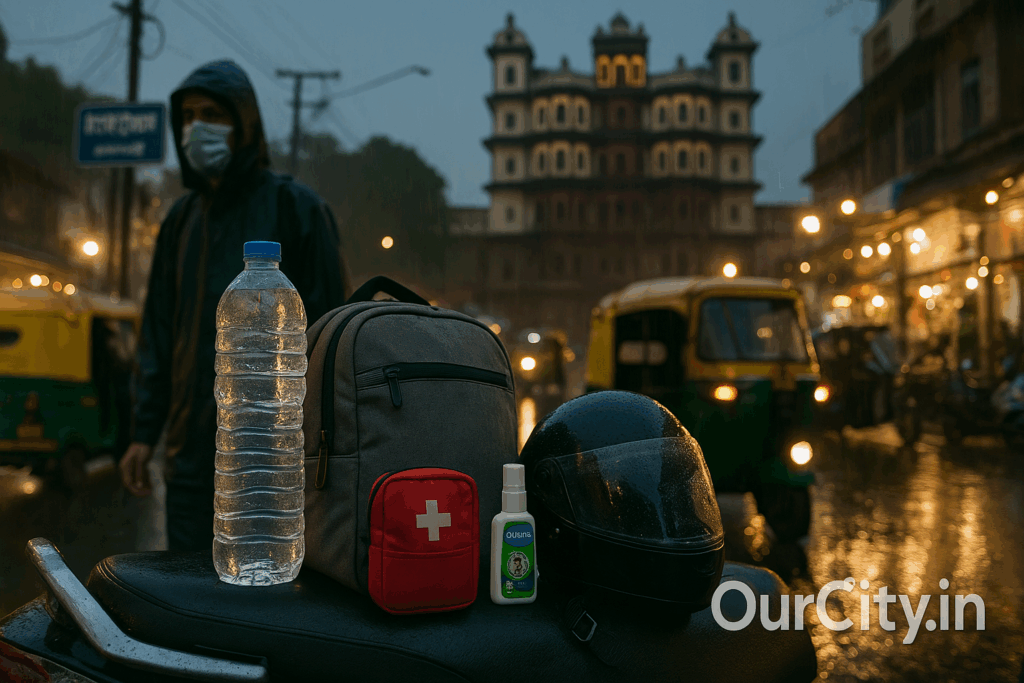
Rain cover: Zip bag for papers, double-cover laptop.
Visors & glasses: Anti-fog wipes; dab liquid soap, wipe thin for DIY anti-fog.
Waterlogging belts to treat with caution: Underpasses and low-lying pockets along Ring Road, near Bengali Square, parts of AB Road closer to culverts, and some lanes around Musakhedi. If water rises above ankle, don’t wade—open drain risk.
Dengue prevention: Window screens, vapourisers/coils, remove standing water in buckets/plant saucers. If fever + body ache, see a doctor; don’t self-medicate beyond paracetamol.
Monsoon Day Plan (example):
-
Carry: Compact umbrella + foldable poncho.
-
Route: Prefer iBus; road shoulders flood first.
-
Food: Stick to fresh hot food. Avoid pre-cut fruits on the street post-rain.
Home monsoon kit:
-
Compact umbrella + poncho
-
Dry bag for electronics
-
Spare sandals + towel by door
-
Basic torch + spare batteries
-
Mosquito repellent & screens repair tape
Winter/Smog Masking & Indoor Air (Dec–Jan spikes possible)
Masks: N95/FFP2 fit snug. Keep a spare in a clean pouch.
Walk windows: Prefer 16:00–18:00 if morning haze hangs.
At home: Keep one room as a “clean room.” DIY: medium HEPA purifier or dust filter taped to a fan (interim). Towel-under-door during worst hours.
Symptoms: Eye irritation, cough—reduce outdoor activity; consider saline nasal rinse; if persistent, see a doctor.
AQI cue card: See the table in Quick Cheatsheets for actions by band.
🩺 Health & Emergencies Without Panic
Hospitals, Ambulance, First Aid
-
Nationwide numbers: 112 (all emergencies), 108 (ambulance).
-
Triage basics: Casualty/ER for urgent care; OPD for routine. Keep Aadhaar, insurance e-card, and one paper photocopy in your wallet pouch.
-
Cashless insurance: Ask “TPA desk kidhar hai?” (Where is the TPA desk?) Hand over ID + policy details. Take photos of all forms you sign.
-
First aid quickies:
-
Dehydration/heat exhaustion: Cool room, ORS sips, loose clothing, wet towel to cool. If confusion/vomiting, hospital.
-
Minor cuts/sprains: Clean with potable water, compress, elevate; basic bandage.
-
Dog/cat bites: Wash with soap/water for 10–15 mins, go to hospital for tetanus/anti-rabies.
-
Food poisoning mild: Fluids, ORS; if high fever, blood in stool, or severe cramps, hospital.
-
Pharmacy & Safe Self-Care
-
Hours: Many chemists around Vijay Nagar, Old Palasia, Geeta Bhawan open late; a few 24×7 pockets exist near larger hospitals—ask local guards.
-
E-pharmacy norms: Keep doctor’s e-prescription PDF for schedule drugs; delivery riders often call—stay reachable.
-
Common OTC (use responsibly): ORS, paracetamol, antacids, rehydration salts, oral antihistamines for allergies. When in doubt, see a doctor.
🛡️ Night & Solo Safety
Women’s Compartment/Coach Pointers
-
On city buses, front rows often prioritised for women—take them. At busy stops like Palasia or LIG, wait under lights and near other commuters. If a bus feels off, skip and take the next.
App Cab vs Street Hail (When & Why)
-
Post 21:00: Prefer app cabs over street hails. Use share trip and keep driver in line-of-sight at pickup.
-
If a driver insists on off-app payment: “Main app se hi karungi/karunga.”
-
If your gut says no: Cancel safely; walk to a brighter, busier flank (malls, fuel pumps, hotels).
Polite Refusal Scripts & Red Flags
-
“Nahi chahiye, thank you.” (No thanks.)
-
“Main app se book kar raha/rahi hoon.”
-
“Police se confirm kar leta/leti hoon.”
-
Red flags: QR code swaps, UPI “collect” requests from unknowns, pressure to share OTPs, drivers avoiding number-plate alignment.
🏠 Housing, PGs & Utilities
Deposits, Clauses & Broker Scripts
-
Broker norms: Often 1 month rent as fee, sometimes half-month.
-
Deposits: Typically 1–3 months; push for lower with stable income proof.
-
Questions to ask:
-
“Water timing kya hai—borewell ya municipal?”
-
“Power backup hai? Inverter capacity?”
-
“DTH/FTTH options?” (Ask for fiber: Nipania, Kanadia Road, Vijay Nagar see good coverage.)
-
-
Clauses to expect: 1-month notice, minor repairs under ₹1,000 by tenant, painting on exit if walls damaged.
-
Scripts:
-
“Deposit kitna refundable hai, aur kab?”
-
“Maintenance mein kya-kya included hai?”
-
Power/Water Outage Playbook
-
Inverter etiquette: Don’t run heavy appliances; charge phones/laptops first.
-
Surge protection: Use spike guards, especially in Rau and Super Corridor where fluctuations occur during storms.
-
Water: Keep one 20–30 L drum topped before monsoon weeks. RO/UV filter—change candles on schedule; keep two spare candles.
Pest & Mosquito Control That Works
-
Quarterly gel treatment for cockroaches; avoid sprays in kitchen.
-
Mosquito mesh repairs before monsoon; larval source reduction in balconies.
-
Agarbatti/coils in evenings if open windows face green belts near Ralamandal or low-lying pockets.
📄 Paperwork That Saves You Time
Tenant Verification & Receipts
-
Indore landlords often request police verification. Visit your local police station or ask the society office; fill the tenant form, attach Aadhaar, photos, and rental agreement copy. Ask for an acknowledgement slip—“Receiving de dijiye.”
E-Challan & Civic Apps
-
Traffic challans: Check on state e-challan portals or the central Parivahan eChallan. Keep vehicle papers scanned in your phone locker.
-
Civic grievances: Indore 311 app covers garbage pickup, roadlights, road damage. Add clear photos and landmark notes (“Near Khajrana temple gate”).
-
Driving rules that trip newcomers: One-way pockets around Rajwada; strict no-parking near Chhappan, MG Road, and Vijay Nagar squares; tow trucks patrol evenings.
💸 Daily Costs & Cash-UPI Rhythm
Sample Budgets & Top-Ups
-
Student day (Bhanwar Kuwa/Geeta Bhawan):
-
Commute: ₹20–40 (bus/iBus)
-
Lunch tiffin/hostel mess: ₹60–120
-
Tea/coffee & snacks: ₹20–60
-
Total: ₹100–220
-
-
Office day (Vijay Nagar/Nipania):
-
Commute mix (iBus + auto): ₹50–150
-
Lunch (thali/quick bowl): ₹120–250
-
Coffee break: ₹40–120
-
Total: ₹210–520
-
-
Metro/bus card top-ups (where applicable): ₹200–500 keeps you flexible for the week.
Emergency Cash & ID Copies
-
Transit pouch: ₹300–500 + photocopies of Aadhaar, DL, one passport photo.
-
Home contingency: ₹1,000–2,000 sealed in a labelled envelope.
-
Use UPI everywhere, but signal dips happen in basements and inside market lanes near Rajwada/Siyaganj—cash helps.
📱 Must-Have Apps & Offline Backups
Official Transport & Traffic Tools
-
AICTSL / iBus info: For routes, station lists, and service notices (use official app or station boards).
-
State e-Challan/Traffic apps: For fines and updates.
-
Maps: Save offline areas covering Ring Road, AB Road, Super Corridor, Rau, and Airport Road.
ICE Contacts & Document Lockers
-
Set your phone’s ICE (In Case of Emergency) widget with two numbers.
-
Keep Aadhaar, insurance, prescriptions, tickets in a phone document locker; mirror to a cloud drive.
-
Add a lock-screen note: first name + emergency number.
Network quirks: Basements and dense Siyaganj lanes drop signal; step out to road edge for UPI.
🚗 Driving, Parking & Towing Traps
Rain Riding & Helmet Basics
-
Helmet: BIS/ISI mark; snug D-ring or ratchet locked. For pillions, keep a spare if you ride often.
-
Rain: Avoid painted lane markers and metal covers—slippery. Slow over first heavy-shower potholes on Ring Road and AB Road; they form fast.
-
Reflective tape: On rear mudguard and backpack—helps at dusk.
No-Parking Pockets You’ll Want to Know
-
Around Rajwada, Sarafa, Chhappan Dukan, MG Road, and Vijay Nagar squares—read boards; tow teams are active on weekends. If towed, check Indore Traffic Police social pages or helpline posts for tow-yard location and challan process.
Airport/rail pickup lanes: Short grace windows; don’t wait in active lanes. Use designated parking if your person is delayed.
🌊 Disaster Readiness (City-Specific)
Flood/Cyclone/Earthquake Notes
-
Flooding: Indore isn’t coastal, but cloudbursts flood underpasses and low pockets along Ring Road and near culverts. If car stalls in water, don’t restart; move to safety and call roadside assistance.
-
Seismic: Follow drop–cover–hold. Use stairs, not lifts after tremors; regroup at open grounds (society park, school grounds).
Go-Bag & Family Plan
-
Go-bag for Indore (compact):
-
Copies: Aadhaar, insurance, rental agreement page
-
1× power bank + cables
-
Torch + batteries
-
2× N95/FFP2, 2× simple masks
-
2 L water + 4 ORS
-
Basic meds (doctor-advised), bandages
-
Multi-tool, whistle, cash ₹1,000
-
-
Family plan: Choose a meet point (e.g., Khajrana outer gate, society clubhouse), define call chain (one out-of-city relative as relay), and assign who grabs docs.
👥 Special Playbooks
Students & Freshers
-
Where you’ll live: Bhanwar Kuwa, Geeta Bhawan, parts of Old Palasia; some shift to Rau for institutes.
-
First-month survival: Lock a tiffin/mess within 500 m, learn your iBus and two auto routes to college/office, keep photocopies in your bag.
-
Study corners: Library rooms near Geeta Bhawan and Old Palasia; look for exam-time quiet slots 10:00–13:00 or 16:00–19:00.
-
Budget snack grid: Poha–jalebi lanes near Chhappan, tea pockets near Siyaganj; keep ₹50 cash.
Solo Women
-
Late-night commutes: Prioritise app cabs with share trip on. If bus needed, wait near lit corners of Palasia, LIG, or Vijay Nagar stops, next to families/office-goers.
-
Elevator vs stairwell: In quiet buildings, prefer elevator over empty stairwells; stand near controls.
-
Trusted fuel/snacks: Branded pumps on AB Road/Ring Road; hot food over cold salads after rain.
-
SOS habits: Keep 112 on speed dial, enable phone emergency SOS, and practise press sequence once.
Parents with Kids
-
Stroller-friendly: Phoenix Citadel, C21, and newer Nipania parks have better paths.
-
Safe play hours: 07:00–09:00 and 17:00–19:00 except heatwave days.
-
Festival crowd rule: At Rajwada/Sarafa, tie a name–phone wristband; agree a meet spot near a fixed landmark (e.g., clock tower flank).
-
Medical: Save routes to paediatric OPDs near Vijay Nagar and Old Palasia.
Elders & PWD
-
Step-free entries: Newer iBus stations have ramp access; use median lifts where available.
-
Low-floor bus pockets: Ask conductors at Palasia/LIG for low-floor arrivals.
-
Hospital windows: 10:00–12:30 OPD is sweet spot; carry printed med list and next-of-kin contact.
✅ Quick Cheatsheets (Tables)
Passes & Fares (typical):
| Mode | Short Hop | Long Hop | Day Pass | Notes |
|---|---|---|---|---|
| iBus BRTS | ₹10–25 | ₹25–60 | ₹60–100 | Buy at station; keep change/UPI |
| City Bus | ₹10–30 | ₹30–60 | ₹60–100 | Ask conductor for route tips |
| Auto (local) | ₹30–100 | ₹100–250 | — | Try meter; fix fare if needed |
| App Cab | ₹120–220 (5–8 km) | ₹220–450 (8–15 km) | — | Surges in rain/late night |
Peak Hours by Corridor (guide):
| Corridor | Morning Peak | Evening Peak | Tip |
|---|---|---|---|
| AB Road (Palasia–Vijay Nagar) | 08:45–10:15 | 18:00–20:15 | Use iBus; rear coach less crowded |
| Ring Road (MR-10–Nipania) | 09:00–10:30 | 18:15–20:30 | Add 10–15 mins buffer in rain |
| Airport Road–Super Corridor | 09:00–10:00 | 18:30–20:00 | Arrive by 09:00 for interviews |
AQI Bands & Actions:
| AQI | What it means | Action |
|---|---|---|
| 0–50 | Good | Outdoor fine |
| 51–100 | Satisfactory | Sensitive groups watch symptoms |
| 101–200 | Moderate | Prefer afternoon walks; close windows early morning |
| 201–300 | Poor | N95/FFP2 outdoors; limit jogging |
| 301–400 | Very Poor | Keep to “clean room”; air purifier on |
| 401–500+ | Severe | Avoid outdoor exertion; masks + indoor air control |
Monsoon Kit (carry):
| Item | Why |
|---|---|
| Compact umbrella + poncho | Sudden bursts |
| Dry bag for phone/laptop | Electronics survive |
| Anti-fog wipes | Helmets & glasses |
| Spare sandals | If feet soak |
| Mosquito roll-on | Evening outdoors |
Heat Kit (carry):
| Item | Why |
|---|---|
| 1L ORS bottle (1 sachet/L) | Hydration + salts |
| Cap/UV umbrella | Head & face shade |
| Light scarf | Neck cooling |
| Reusable bottle | Refill at malls/offices |
| Electrolyte tabs | Backup |
Go-Bag (home):
| Item | Count | Note |
|---|---|---|
| Water | 2 L | Rotate stock |
| ORS | 4 | Sachets |
| Power bank | 1 | Full charge |
| Torch + batteries | 1 | Check monthly |
| N95/FFP2 | 2–4 | In zip pouch |
| Cash | ₹1,000 | Small notes |
| Doc copies | — | ID, insurance |
“Arrive by” Cues:
| Place | Arrive by | Why |
|---|---|---|
| Super Corridor offices | 09:00 | Security, lights, meetings |
| Rajwada shopping | 17:30 | Parking, evening crowd |
| Chhappan food lane | 19:00 | Pre-peak, easy seating |
| Airport pickup | +15 mins buffer | Lane grace windows |
Locals say… “Keep a rain pouch, keep a night cab, and keep your ORS.”
❓FAQs
1) Is iBus faster than an auto on AB Road?
Usually yes in peak hours because buses use dedicated lanes and median stations. For 1–2 km hops, an auto may still be quicker door-to-door.
2) What should I say if an auto won’t start the meter?
“Bhaiya, meter se chaliye” first. If no, get a fair fixed quote: “Fixed rate kitna? Receipt dena.” Or switch to an app cab.
3) What’s the safest payment method?
UPI is king, but watch QR code swaps. Check merchant name on your screen before paying. Don’t approve “Collect” requests you didn’t initiate.
4) Best time to commute in summers?
Before 09:00 and after 16:30. Carry ORS and plan indoor work mid-day.
5) Where does waterlogging get tricky?
Underpasses/low sections along Ring Road and parts of AB Road near culverts; some lanes near Musakhedi. If water crosses ankle, don’t wade.
6) Which mask for smoky days?
N95/FFP2 with snug fit. Prefer evening walks when sun’s lower and air can improve.
7) I lost my phone/wallet in a market—what now?
Use a friend’s phone to lock accounts (UPI, email), call 112, and note the spot (“near Rajwada clock tower flank”). File a report; keep IMEI handy in your doc locker.
8) How do I avoid towing near food streets?
Park in marked lots near Chhappan or use autos/cabs. Weekends are strict. If towed, check official Traffic Police channels for tow-yard details.
9) Do I need tenant verification?
Many societies/owners expect it. Visit local police station or ask society office and take an acknowledgement slip.
10) What’s a smart night commute from Sarafa?
App cab from a well-lit main road corner, share trip, confirm number plate, sit rear-left.
11) Any quick student money saver?
Split rides into two short autos vs one long in gridlock; use buses for the long stretch and auto for the last km.
12) How to keep dengue away at home?
Screens, coils in evenings, no standing water in buckets/balconies, and see a doctor if fever + aches.
13) How much emergency cash should I carry?
₹300–500 in a transit pouch; ₹1,000–2,000 at home sealed.
14) Which side of iBus to stand for quick exits?
At big stations like LIG or Palasia, align near the footbridge end; watch floor arrows toward exits.
15) What do I do if an app driver insists on off-app payment?
“Main app se hi karunga/karungi.” If pressure continues, cancel in a safe, lit area and rebook.
🔚 Wrap-Up: You’ll Be Fine Here
Indore is practical and kind—people will guide you if you ask clearly. Keep small scripts handy, plan for heat and sudden rain, and use buses/autos smartly. Name-drops that help: Vijay Nagar, Palasia, Rajwada, Sarafa, Chhappan, Geeta Bhawan, Bhanwar Kuwa, Nipania, Kanadia Road, Super Corridor, Rau, MR-10, Bengali Square, Musakhedi, Laxmibai Nagar, Pardesipura, Rajendra Nagar, Ralamandal, Airport Road, Old Palasia, New Palasia. That’s your city map in words.
One last insider cue: In monsoon, keep your shoes dry and your temper cooler—there’s always an iBus every few minutes and a hot cup of chai two turns away.