Surat Survival Hacks
Table of Contents
Surat Life Hacks & Survival Guide
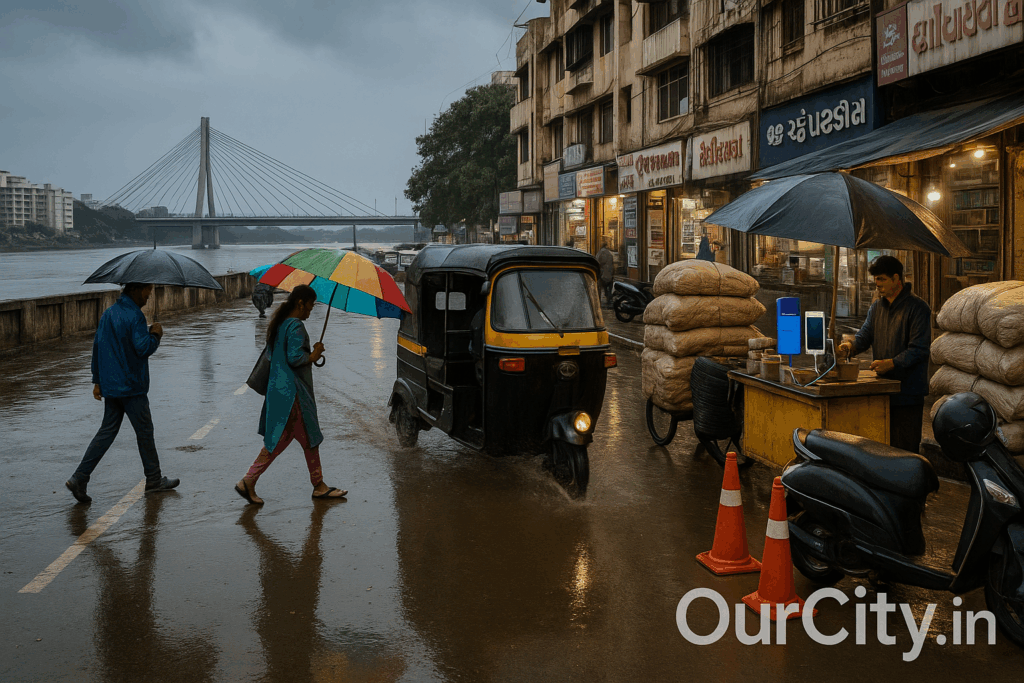
Surat is quick on its feet. Textiles hum in Katargam, diamonds move in Varachha, cafés fill up in Vesu–Piplod, and the old city around Chowk still pulls crowds. The weather swings from sticky heat to sudden downpours. Traffic looks chaotic but follows a rhythm. Newcomers usually misjudge two things: how humid it gets and how fast plans can crumble during a heavy shower. This guide gives you clean, local steps—what to say to an auto, which time windows to avoid, where to stand on platforms, what to keep in your bag in April, and how to move calmly when the Tapi swells.
You’ll find tight scripts, price bands, time cues, and small habits that locals swear by. Read once. Screenshot a few tables. You’ll be fine here.
🧭 Why These Survival Hacks Matter in Surat
On Day 1 you just want to reach work on time and eat a decent lunch. By Week 4 you need rain-day backups, power-cut routines, and the confidence to say “Nahi chahiye, thank you” without guilt. Surat’s core challenges are simple: heat + humidity (Apr–Jun), intense but short monsoon bursts (Jun–Sep), and traffic that ebbs around markets and shift changes in Udhna–Pandesara industrial belts. This guide solves the basics with:
-
Clear scripts for autos and brokers.
-
Seasonal kits that actually fit in your bag.
-
Women’s safety cues rooted in real routes and waiting spots.
-
Local time cues—reach earlier, stand at the right end, pick the safer exit.
Let’s set up your everyday moves.
🚇 Move Smart Every Day
Metro/Train/Bus Basics
City buses (Sitilink) are the backbone. BRTS corridors link Adajan–Athwa–Nanpura–Udhna with hubs near Athwa Gate, Udhna Darwaja, and Ring Road textile markets. Regular city buses fill gaps to Vesu, Piplod, Althan, Pal, and Sarthana. Reserved seats are marked for women, seniors, and persons with disabilities—use them and respect them.
-
Tickets & passes: Expect single-ride QR tickets on the official bus app or paper tickets from conductors. Day passes typically sit in the ₹50–₹100 range; check the official app for live fares.
-
Smart habit: Keep ₹50–₹100 in small notes for buses and e-rickshaws when UPI hiccups.
-
Suburban/rail: Surat is a key Western Railway stop. MEMU/express trains link Valsad, Navsari, Bharuch, Vadodara, and Ahmedabad. For daily intercity commuters, set up UTS and IRCTC Rail Connect apps and keep a photocopy of an ID in your bag.
Locals say: “Textile belt crowds peak near Ring Road post-17:30. Leave by 17:15 if you can.”
About the Metro: The Surat Metro is under construction. Treat all “first/last train” and fare details as “check the official metro site/app” items for now. Plan city travel with buses, autos, cabs, and walking links.
Women-only spaces: On buses, look for marked seats. At the railway station, use brighter, busier FOBs (foot overbridges) and wait near families or well-lit kiosks.
Walkable shortcuts:
-
Nanpura ↔ Athwa Gate: river-side footpaths are cooler after 17:30.
-
Ghod Dod Road ↔ City Light: use inside lanes after 20:00; they’re calmer than the main road.
-
Vesu–Piplod mall zone: mall-to-mall foot links exist; safer in groups post-21:00.
Auto/Taxi Fair-Play (Scripts + Price Cues)
Autos and e-rickshaws rule short hops. Many run fixed rates by distance/landmarks.
Scripts to use confidently
-
“Bhaiya, meter se chaliye.”
-
“Fixed rate kitna? Receipt dena.”
-
“Mujhe Athwa Gate jana hai, left se nikaalna.”
-
“Main app se book kar raha/rahi hoon.” (when you prefer a cab)
Price cues (typical ranges, confirm on ground):
-
Auto/e-rickshaw: ₹12–₹18 per km equivalent on short hops; night or heavy rain may add ₹10–₹30.
-
App cabs: Base fares look tempting, but check surge. Night surges and rain surges can double your fare.
-
Airport (Magdalla) rides: Expect luggage or pickup-lane fees in some cases; app shows the breakup.
Fairness checks:
-
Start with route clarity: “Athwa Gate via Nanpura, seedha.”
-
Share live location with a friend.
-
At night (post-21:00), prefer app cabs over street hails.
Peak Hours & Platform Positions
Peak windows to avoid if you can: 08:30–10:00 and 18:00–20:30 on major bus corridors and around Surat Railway Station and Ring Road.
Platform/coach positioning cheats:
-
On busy bus corridors, stand near the front door for quicker boarding when it’s crowded.
-
At Surat Railway Station, use the clearest FOB you can see; the newest or widest tends to be calmer than the nearest.
-
If you have luggage, reach 20 minutes earlier than you think you need. Ticket queues and platform changes do happen.
🕔 Commuter Cheat Codes
Interchange hacks (save minutes):
-
Athwa Gate: Good hub for switching between Adajan/Pal and Nanpura/Ghod Dod Road directions. Stand closer to the last 3 bus doors—you’ll be near the pedestrian crossings.
-
Udhna Darwaja: Link to Udhna–Pandesara industrial pockets. For a quick exit, aim for mid-bus so you land close to the zebra and avoid backtracking.
-
Ring Road textile belt: For short errands, get off one stop earlier to skip choke points right outside big markets.
Park-and-ride ideas:
-
Vesu/Piplod mall zone: Use mall parking during off-peak hours and bus onward; always follow posted rules.
-
Pal–Adajan side: Larger internal roads allow safe day parking in legal slots; switch to bus for Athwa/Nanpura.
-
Near Sarthana Nature Park & Zoo: Legal day parking around outer roads; bus into central zones.
(Always confirm local rules and any time caps.)
Rain-day reroutes:
-
Prefer BRTS corridors with raised platforms when streets waterlog.
-
Shift your “arrive by” time 30–45 minutes earlier during active showers.
-
If a road looks like a stream, it probably is—don’t argue with floodwater.
Sample corridor rhythms:
-
Adajan ⇄ Athwa Gate ⇄ Nanpura: Mornings are smoother if you reach by 08:15; evenings thin after 20:30.
-
Varachha ⇄ Station ⇄ Udhna: Shift changes create 18:00 pressure; leave by 17:30 if possible.
-
Katargam ⇄ Ring Road ⇄ Udhna Darwaja: Textile movements spike 09:30–11:00 and 18:30–20:00; plan pickups outside those slots.
🌤 Weather Playbooks That Actually Work
Surat is humid. Heat sneaks up on you; monsoon bursts are powerful; winter is mild but pollution can creep up near industrial belts and highways.
Heatwave Kit & Day Plan (Apr–Jun)
Carry: 1–2L water, ORS (1 sachet per 1 L rule), cap/UV umbrella, light cotton/linen, small towel, roll-on sunscreen.
Refill points: office dispensers, malls in Vesu/Piplod, big stores around Ghod Dod Road, bus hubs.
Walk windows: 07:00–09:00 and 17:30–20:00. Avoid noon sun on open bridges and flyovers.
Warning signs: headache, cramps, dry mouth, dizziness.
First aid: move to shade/AC, sip ORS slowly (not chugging), wet towel on neck, see a doctor/hospital if vomiting or confusion starts.
Micro-Checklist: Heat Kit
-
1L water + 1 ORS sachet (min)
-
Cap/UV umbrella
-
Light scarf for sun + dust
-
Sunscreen + lip balm
-
Spare T-shirt if you sweat heavily
Monsoon Kit, Routes & Food Safety (Jun–Sep, varies)
Footwear: quick-dry sandals with grip; avoid smooth leather soles.
Eyes & fog: anti-fog wipe for glasses/helmets.
Bags: rain cover; zip pouches for phone/papers.
Waterlogging cues: low-lying stretches near creeks and the Tapi—Rander, parts of Adajan, pockets in Varachha, and Udhna/Pandesara industrial lanes can see pooling. If ankle-deep water forms, don’t wade—hidden potholes and open drains are real risks.
Food safety: stick to fresh, hot foods; avoid cut fruit lying open; keep a small handwash sachet.
Dengue controls: window screens, coils, weekly check for standing water in buckets, planters, coolers.
Micro-Checklist: Monsoon Kit
-
Foldable umbrella + phone pouch
-
Quick-dry sandals with tread
-
Spare socks in a zip bag
-
Microfiber towel + sanitizer
-
ORS + basic band-aids
-
Small torch (power cuts happen)
Winter/Smog Masking & Indoor Air (Dec–Feb)
Winters are light, but AQI can swing near highways/industrial belts (Hazira, arterial roads).
Mask: N95/FFP2 with snug fit.
Walk window: later mornings (after 09:00) or late afternoons.
At home: a room with a closed door and a HEPA purifier helps. DIY: a clean fan + high-MERV prefilter fixed safely in front; keep it stable and away from kids.
Towel-under-door hack works during smoky nights.
AQI Bands & Actions
| AQI | Air Quality | What you should do |
|---|---|---|
| 0–50 | Good | Open windows, normal outdoor time |
| 51–100 | Satisfactory | Short outdoor exercise ok |
| 101–200 | Moderate | Masks for long walks, reduce kids’ outdoor time |
| 201–300 | Poor | N95/FFP2 outdoors, close windows near roads |
| 301–400 | Very Poor | Stay indoors if possible, purifier on |
| 401–500 | Severe | Essential travel only, masks on, indoor air control |
🩺 Health & Emergencies Without Panic
National numbers: 112 (all emergencies), 108 (ambulance). Save both.
City helpline types (find on official sites):
-
Women’s safety helpline (181)—counselling and assistance.
-
Traffic control room—accidents, towing info, diversions.
-
Municipal control room (SMC)—water/power complaints, tree fall, flooding, solid waste.
Search by official app/website; don’t trust random flyers.
Hospitals—how to choose fast:
-
Government: New Civil Hospital (Majura Gate) and SMIMER handle emergencies; queues can be long but costs are lower.
-
Private: Multispeciality options across Vesu, Piplod, Adajan, Katargam. Carry insurance e-card and a photo ID.
Carry (always):
-
Photo ID (one paper copy + digital scan)
-
Insurance details (TPA, cashless network)
-
List of regular medicines + allergies
First-aid minis:
-
Dehydration/heat: ORS sips, shade/AC, doctor if vomiting/fainting.
-
Minor cuts/sprains: clean water wash, antiseptic, compression wrap; if deep/dirty, hospital.
-
Dog/cat bite: wash 15 minutes with running water + soap; visit a hospital for tetanus and anti-rabies advice.
-
Food poisoning: fluids, ORS; if high fever, blood in stool, or severe cramps—hospital.
Pharmacies: Many stay open late near Ghod Dod Road, City Light, Varachha, Adajan. E-pharmacies deliver; keep an address landmark ready.
🛡️ Night & Solo Safety
Night-travel rules of thumb:
-
After 21:00, prefer app cabs; share trip and live location.
-
Use brighter arterial roads (Ghod Dod Road, Dumas Road) rather than empty internal lanes.
-
Wait where families stand—near mall entrances, busy petrol pumps, or staffed security posts.
Pickpocket red-flag zones (by place type): crowded market lanes (Ring Road textile, Salabatpura, Chowk), festival grounds, station FOBs. Keep phones zipped and front-carry your bag.
ATM & digital payment safety:
-
QR-swap scam: verify shop name on the UPI screen.
-
Wrong UPI request: never “approve” pull requests from strangers.
-
Card skimmers: tug the reader; if loose, skip the machine.
Polite disengage scripts:
-
“Nahi chahiye, thank you.”
-
“Main app se book kar raha/rahi hoon.”
-
“Police se confirm kar leta/leti hoon.”
Solo-women cues:
-
Sit near the conductor or front area in buses if that feels safer.
-
Avoid empty stairwells; wait near well-lit kiosks.
-
Keep a small whistle on your keychain; it cuts through traffic noise better than shouting.
🏠 Housing, PGs & Utilities
Where people look:
-
Students/freshers: Vesu, Piplod, City Light, Althan (PGs, easier commutes).
-
Families: Adajan, Pal, Athwa, Bhatar (parks, schools, quieter).
-
Textile/diamond workers: Varachha, Katargam, Salabatpura.
-
Industrial staff: Udhna, Pandesara, Sachin.
Broker norms: often 1 month’s rent as fee; deposits 2–3 months. Get every promise in the agreement.
Scripts to ask:
-
“Deposit kitna refundable hai, aur kab?”
-
“Maintenance mein kya-kya included hai?”
-
“Water timings aur source (SMC/borewell) kya hai?”
Clauses to expect: 1–2 month notice period, minor repairs by tenant, painting on exit, late-payment charges.
Power cuts:
-
Keep a small LED lamp, power bank, and a charge routine (phones charged by 22:00).
-
Use surge protectors for PCs/TVs.
-
Refrigerator rule: minimize door opens during outages.
Water:
-
Store one drum per person for 24 hours.
-
RO/UV: change filters on schedule; keep one sealed 5L bottle for boil-notice days.
Pest & mosquito control (works locally):
-
Weekly drain of coolers/planters; cover buckets.
-
Use window screens; coils or plug-ins at dusk.
-
For termites, get professional treatment—DIY sprays don’t last.
📄 Paperwork That Saves You Time
Tenant/police verification: Many landlords expect it. Visit the local police station with ID copies and the leave & license agreement; ask for an acknowledgement slip.
E-Challan checks: Use the official e-challan portal/app; verify vehicle number carefully.
Civic grievance apps: The SMC official app lets you report potholes, streetlights, garbage pickups, and water issues—attach a photo and note the ticket number.
Driving rules that trip newcomers:
-
One-ways in the old city (Nanpura/Chowk) change; check signs.
-
No-parking near Surat Railway Station, Athwa Gate, parts of Ring Road—tow trucks patrol often.
-
Always carry a soft copy of RC/insurance/PUC (DigiLocker/mParivahan accepted).
💸 Daily Costs & Cash-UPI Rhythm
Sample daily budgets (typical):
-
Commute (bus): ₹20–₹60 one way, or a day pass ₹50–₹100.
-
Auto short hops: ₹60–₹180 depending on distance and traffic.
-
Lunch: ₹120–₹200 for a simple Gujarati thali; ₹60–₹120 for thepla/khichdi/poha combos.
-
Tea/coffee: ₹10–₹25 for chai; ₹120–₹200 for café coffee.
Cash vs UPI:
-
UPI works almost everywhere, but small vendors may want ₹10–₹20 cash.
-
Keep ₹300–₹500 as contingency: split between wallet and a small transit pouch.
Top-ups:
-
Keep bus app wallet ready for QR tickets.
-
If you use a prepaid transit card (when available), set a monthly reminder to top up.
Micro-Checklist: Money Safety
-
₹300–₹500 split cash
-
ID photocopy + digital scans
-
Two UPI apps on phone (in case one fails)
-
PIN lock and screen lock on
📱 Digital Life & Must-Have Apps
-
Official transport: Sitilink/Surat Bus app for routes, QR tickets, and passes.
-
Trains: IRCTC Rail Connect, UTS for unreserved suburban/intercity.
-
Traffic & e-challan: Gujarat’s official e-challan app/portal; follow Surat Traffic Police updates on their verified social handles.
-
Civic: Surat Municipal Corporation (SMC) app for grievances, taxes, and water updates.
-
Payments: Any UPI app; add BHIM as a backup.
-
Emergency: 112 India app; phone ICE (In Case of Emergency) contact on lock screen.
-
Docs locker: DigiLocker, mParivahan.
-
Maps: Save offline maps for central Surat and coastal stretches (Dumas/Hazira)—helpful during network drops in heavy rain.
Network quirks: Basements in malls and dense markets (textile warehouses around Ring Road/Salabatpura) can be patchy. Download QR tickets before you go underground.
🚗 Driving, Parking & Towing Traps
No-parking pockets (typical):
| Zone | What to watch | Tip |
|---|---|---|
| Surat Railway Station area | Tow trucks, fast turnovers | Use official lots; don’t “just 5 minutes” it |
| Ring Road textile belt | Loading zones, double-parking | Park farther and walk; saves a 30-min jam |
| Athwa Gate/Nanpura | Peak-hour clearways | Time visits post-20:30 or pre-09:30 |
| Ghod Dod Road–City Light | Short-stay rules near cafés | Look for multi-storey/official parking |
| Dumas Road–Piplod malls | Pickup lanes timed | Read the lane signboards; keep engine off |
Helmet & BIS/ISI: If you ride, ISI-marked helmets only. Chin strap always. Rain reduces visibility—keep a visor wipe.
Overtaking in rain: Avoid puddle edges; potholes hide there. Don’t tail buses; spray blinds you.
Airport/Rail pickups: There’s usually a short grace period—watch lane rules and signboards rather than relying on hearsay.
🌊 Disaster Readiness (City-Specific)
Surat has a flood memory. The Tapi and creeks respond fast to heavy rain and upstream releases. Coastal winds near Hazira and Dumas can be strong during cyclonic systems.
If flood-prone alerts rise:
-
Park on higher ground; avoid basement parking.
-
Keep one backpack ready: snacks, water, torch, power bank, basic meds, ID copies.
-
Avoid walking in moving water; depth is deceptive and open drains are a real hazard.
-
Turn off main power if water enters the home.
Earthquake basics:
-
Drop–Cover–Hold under a sturdy table, away from glass.
-
Use stairs, not lifts, when it’s safe to exit.
-
Decide a family meetup point (nearby temple/park gate).
Compact Go-Bag: Surat Edition
| Item | Why it matters |
|---|---|
| IDs + insurance (paper + digital) | Hospitals/border checks |
| 2L water + ORS | Heat + flood delays |
| Dry snacks (thepla/khakhra) | Stable in humidity |
| Torch + batteries | Night cuts |
| Power bank + cables | Keep comms alive |
| Small first-aid kit | Cuts/sprains |
| Spare T-shirt + scarf | Heat/soak |
| Zip pouches | Phones & papers dry |
👥 Special Playbooks
Students & Freshers
-
Stay zones: Vesu, Piplod, City Light, Althan keep you near libraries, cafés, and bus links.
-
First-month routine: fix a 7-day meal loop (mess + 2 budget eateries), set a laundry day, and a Sunday paperwork hour (ID scans, fee receipts).
-
Study pockets: Quiet after 21:00 in most societies; use morning 07:00–09:00 for high-focus reading.
-
Exam season: Save PDFs offline, keep a second hotspot (friend/phone) for sudden Wi-Fi drops.
Solo Women
-
Prefer app cabs post-21:00; share live location.
-
In buses, front-area seating or near the conductor.
-
Choose brighter exits at stations/malls; if a lift looks empty, wait for the next or take stairs near traffic.
-
Keep a peppermint or clove—small, but helpful for nausea in crowded rides.
-
Trusted quick snacks: thepla, khakhra, murmura—light and safe.
Parents with Kids
-
Parks & walks: Early evenings (17:30–19:00) in Adajan, Pal, Athwa parks; mornings are best in Vesu–Piplod.
-
Strollers: Sidewalks on Ghod Dod Road are better kept than old-city lanes.
-
Festivals: Use a child-ID wristband (name + guardian phone). Fix a lost-and-found point before the event starts.
Elders & PWD
-
Prefer low-floor buses; ask conductors for ramp help if available.
-
Lift reliability is better in new malls/offices around Piplod–Vesu than in older markets.
-
For hospital visits, aim 09:30–11:30 or 16:00–18:00—quieter than noon crowds.
✅ Quick Cheatsheets (Tables)
Peak Hours by Corridor
| Corridor | Morning crowd | Evening crowd | “Arrive by” cue |
|---|---|---|---|
| Adajan–Athwa–Nanpura | 08:45–10:00 | 18:30–20:15 | 08:15 / 20:30 |
| Varachha–Station–Udhna | 09:00–10:30 | 18:00–20:30 | 08:30 / 17:30 |
| Katargam–Ring Road–Udhna D. | 09:30–11:00 | 18:30–20:00 | 09:00 / 20:30 |
Heat Kit Checklist
| Item | Pack? |
|---|---|
| 1–2L water + ORS | ✓ |
| Cap/UV umbrella | ✓ |
| Light cotton/linen | ✓ |
| Small towel | ✓ |
| Sunscreen | ✓ |
Monsoon Kit Checklist
| Item | Pack? |
|---|---|
| Umbrella + phone cover | ✓ |
| Quick-dry sandals | ✓ |
| Spare socks | ✓ |
| Microfiber towel | ✓ |
| Band-aids + sanitizer | ✓ |
Go-Bag Essentials
| Item | Pack? |
|---|---|
| IDs (paper + digital) | ✓ |
| Power bank + cables | ✓ |
| Torch | ✓ |
| 2L water + ORS | ✓ |
| Dry snacks | ✓ |
“Arrive By” Timing Cues
| Task | Time cue |
|---|---|
| Railway departure | Reach 45 min early with luggage |
| Textile market errand | Before 11:00 or after 19:30 |
| Mall pickup (Piplod) | Plan 15 min for lane rules |
| Airport pickup | Check lane signboards; keep buffer |
❓FAQs
Q1. How do I avoid rain chaos on workdays?
Check the bus app 15 minutes before leaving. Carry monsoon kit. Leave 30–45 minutes earlier if showers are active, and use BRTS corridors where platforms sit higher.
Q2. Are autos safe late at night?
After 21:00, prefer app cabs so trip details are recorded. Share live location and sit behind the driver.
Q3. Where does waterlogging usually happen?
Low-lying belts near creeks and the Tapi—Rander, parts of Adajan, pockets in Varachha, and Udhna/Pandesara lanes. Follow official alerts and avoid wading.
Q4. What mask should I wear on poor AQI days?
N95/FFP2 with a snug fit. Plan walks after 16:00 on hazy days and keep windows closed near highways.
Q5. How do I check a traffic fine?
Use the official e-challan app or portal. Verify vehicle number carefully; avoid third-party payment links from messages.
Q6. What’s a basic daily budget?
₹250–₹500 covers bus commutes, chai, and a simple lunch. If you cab both ways, plan ₹500–₹900 depending on distance/surge.
Q7. How do I refuse touts or pushy sellers?
“Nahi chahiye, thank you.” If pressured: “Police se confirm kar leta/leti hoon.” Walk towards brighter, busier areas.
Q8. If I lose my phone/wallet?
Use a friend’s phone to lock UPI quickly; call your bank hotlines; file an e-FIR/complaint with the local police; track via cloud if enabled.
Q9. Which areas are calmer in the evening for a walk?
Ghod Dod Road side lanes, City Light internal roads, Adajan–Pal parks—earlier in the evening is better; stay off empty stretches post-21:00.
Q10. What’s a safe, quick snack during travel?
Thepla, khakhra, murmura, or hot fresh snacks. Avoid cut fruit standing in the open during monsoon.
Q11. How do I handle a dog bite?
Wash the wound for 15 minutes with water and soap. Go to a hospital for tetanus and anti-rabies advice—don’t wait.
Q12. Any women-specific coach or seat tips?
Use marked seats in buses. At stations, wait near families and staffed areas; choose brighter exits and avoid empty stairwells.
Q13. Can I depend only on UPI?
Mostly, yes—but keep ₹300–₹500 split cash for outages or small vendors.
Q14. What about Surat Metro?
It’s under construction; check the official metro site/app for timelines. For now, base commutes on buses, autos, and cabs.
Q15. How do I report potholes or garbage pickup issues?
Use the SMC official app. Attach a photo, note the ticket number, and add a landmark.
🔚 Wrap-Up: You’ll Be Fine Here
Surat runs on hustle and small courtesies. Say “Please” and “Thank you,” respect queues, and keep your bag light but ready—ORS in April, umbrella in July, a mask in January. Name-drop landmarks, share your ride, and follow bright routes. When the city breathes easy—on a breezy Ghod Dod evening or at Dumas after the sun dips—you’ll feel it: the rhythm that locals rely on. Welcome to Surat. Keep this guide handy, and pass the hacks forward.