Ahmedabad Shopping Guide
Table of Contents
Ahmedabad Markets & Shopping: Fair Prices, Real Finds
Ahmedabad is a city that still loves a good bhaav talk. Clusters of old-city lanes spill out yards of bandhej and mirror-work, while new corridors sell slow, careful cottons and clean-cut furniture. First-timers often misjudge timing (reach too late and it’s a crush), skip the bill (then regret warranty issues), or haggle wrongly (pushy tone, poor script). This guide cuts the noise. You’ll get a mental map of the bazaars, what to buy (and what to skip), simple bargaining scripts (English/Hindi/Gujarati), quality checks you can do on the spot, and the hours locals actually shop.
Small note: weekly offs and store timings vary by area and festival seasons. Always check the market’s on-ground signage or the Ahmedabad Metro/BRTS official apps before you go.
🧭 Why Shop Ahmedabad
Ahmedabad sits at a sweet spot—close to Kutch and Saurashtra craft belts yet very much a big trading city. That means:
-
Textile power: bandhej (tie-dye), Ajrakh-inspired block prints, fine cottons, festive chaniya choli sets, dupattas with mirror-work, and Patola-inspired designs (original Patola comes from nearby Patan, but Ahmedabad sells a wide range of lookalikes and contemporary weaves).
-
Jewellery & metals: silver jewellery lanes, brass and copper utensils for the home, pooja ware.
-
Seasonal stars: kites and manja for Uttarayan (January), garba gear for Navratri (Sep/Oct), Diwali gifting.
-
Daily-value streets: readymade wear, bags, juttis/mojari, houseware, budget electronics, stationery and second-hand books.
Go in with a plan: which cluster, what hours, cash vs UPI, when to ask for a GST bill, and how to pack if it rains. You’ll save time and money—and enjoy the browsing more.
🗺 Market Map in Words
The Big 5–9 Areas
Here’s the city’s shopping map in plain words. Think of it as zones rather than single lanes—each has sub-streets.
-
Manek Chowk – Bhadra – Teen Darwaza (Old City Core)
Best for: Gold/silver jewellery clusters by day, budget streetwear and accessories around Bhadra, night-time food scene later.
Vibe: Crowded, historic, bargain-friendly.
Weekly off: Varies by lane; many jewellery shops shut on Sunday.
Best hours: 11:00–15:30 for calmer browsing; avoid 18:00–20:00 rush.
Landmarks named by locals: Bhadra Fort, Teen Darwaza, Gandhi Road. -
Dhalgarwad – Sindhi Market – Ratan Pol – Maskati Market (Textile Quadrant)
Best for: Dress materials, bandhej, cottons, dupattas, lehenga fabrics; trims and laces in by-lanes.
Vibe: Budget-to-wholesale; serious fabric people shop here.
Weekly off: Often Sunday (textile wholesale varies).
Best hours: 11:00–14:00 and 16:00–19:00.
Nearby names: Kalupur, Raipur, Gheekanta. -
Lal Darwaja – Relief Road – Gandhi Road (Street + Electronics/Houseware)
Best for: Wallet-friendly clothing, bags, belts, toys, houseware; pockets of electronics and mobile accessories on Relief Road.
Vibe: Street hustle; bargain hard but fair.
Weekly off: Typically Sunday for many lanes.
Best hours: 11:00–13:00; after 17:00 it’s shoulder-to-shoulder.
Nearby: Bhadra, Ellis Bridge end, Delhi Darwaza side if you roam. -
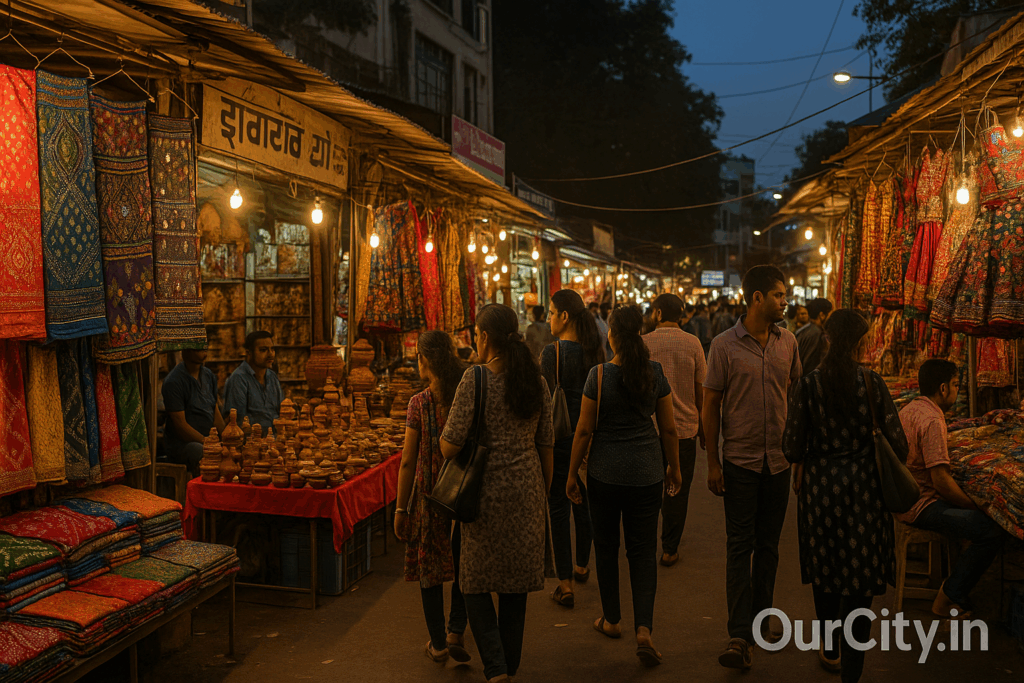
Law Garden Night Market – Netaji Road (Navratri Central)
Best for: Chaniya-choli, mirror-work jackets, bandhej dupattas, oxidised jewellery; all year, but explodes near Navratri.
Vibe: Festive, touristy, mixed pricing.
Weekly off: Usually none; stalls vary.
Best hours: 18:00–21:00 for the vibe; 17:00 if you want trial space.
Nearby: Law Garden, Ellisbridge, Paldi, Navrangpura. -
Kalupur – Old City Book/Stationery Pockets
Best for: Academic books, stationery, exam guides; scattered second-hand finds.
Vibe: Functional, student-heavy.
Weekly off: Often Sunday.
Best hours: 12:00–17:00.
Nearby: Kalupur Railway Station, Sarangpur. -
Ravivari (Gujari Bazaar) – Riverfront (Sunday Flea)
Best for: One-Sunday-only flea on the Riverfront side—furniture odds, hardware, cycles, knick-knacks, household items.
Vibe: Hunt-and-peck treasure market; be early and be picky.
Weekly off: It actually runs on Sunday (morning).
Best hours: 07:30–11:00 (arrive early).
Nearby: Ellis Bridge, Riverfront walkway. -
C.G. Road – Ashram Road – S.G. Highway (Showrooms & Malls)
Best for: Branded apparel, electronics with warranty, home decor showrooms, furniture.
Vibe: Fixed-price, comfort shopping.
Weekly off: Mostly open all week; a few showrooms close one weekday (varies).
Best hours: 12:00–16:00 on weekdays; weekends get busy.
Nearby: Navrangpura, Vastrapur, Thaltej, Prahladnagar. -
Jamalpur (Flower & Fresh)
Best for: Early-morning flower market, pooja items, some fruits/veg.
Vibe: Wholesale energy at dawn.
Weekly off: Varies; often active daily.
Best hours: 05:30–08:30 for serious buyers.
Nearby: Jamalpur Bridge, Danilimda side. -
Kite & Seasonal Clusters (Uttarayan / Navratri pop-ups)
Best for: Kites, manja spools, safety gloves (Jan); seasonal fairs and garba gear in Sep/Oct.
Vibe: Seasonal buzz, bulk buying.
Weekly off: Seasonal; check week’s plan.
Best hours: 10:00–13:00 before stock thins.
Where people say: Raipur Darwaza area, Khadia pockets, Bapunagar, Khamasa when season peaks.
How Crowds Flow by Time/Day
-
Weekday late mornings (11:00–13:00): Best for fabric and jewellery browsing without elbow wars.
-
Evenings (17:00–20:00): Everyone comes out; expect slow walking in Lal Darwaja, Law Garden, Bhadra.
-
Sundays: Many old-city textile and jewellery lanes shut; plan showroom runs on C.G. Road/S.G. Highway or the Ravivari flea morning.
-
Festive weeks (Diwali/Navratri/Uttarayan): Start 10–12 days early for choice; evenings are mood but queues are long.
🛒 What to Buy & Price Bands
City-Special Buys (₹ ranges)
| Category | ₹ Street | ₹₹ Budget Stores | ₹₹₹ Branded/Boutique |
|---|---|---|---|
| Bandhej dupatta/cotton | 350–900 | 900–1,800 | 1,800–4,000+ |
| Ajrakh/Block-print yardage (cotton) | 180–350/m | 350–600/m | 700–1,200/m |
| Chaniya-choli (festive sets) | 1,200–3,500 | 3,500–8,000 | 8,000–25,000+ |
| Mirror-work jackets/sets | 500–1,200 | 1,200–2,800 | 3,000–7,000 |
| Oxidised silver-look jewellery | 150–800 | 800–1,800 | 2,000–5,000 |
| Silver (by weight; making extra) | Market rate | Market rate | Reputed jewellers |
| Mojari/jutti | 300–900 | 900–1,800 | 2,000–4,000 |
| Brass/copper cookware (per piece) | 500–2,000 | 1,800–4,500 | 4,500–8,000+ |
| Kites & manja (seasonal) | 4–15/kite | 15–40/kite | Branded packs vary |
| Khadi/handloom cotton kurta | 600–1,200 | 1,200–2,200 | 2,500–5,000 |
Context: Street prices vary with fabric quality, handwork density, and season. Boutique Patola (authentic double-ikat from Patan) sits far higher—treat those as heirloom pieces and buy from reputed sources only.
What Not to Buy Here (or When to Skip)
-
Open-air leather after a shower—moisture can warp soles and stain.
-
Over-embroidered chaniya cholis right before Navratri if you haven’t checked stitching and lining—queues for alterations will eat time.
-
“Vintage” metalware with suspect patina from the flea—assume it’s just aged-looking; buy for decor value, not as a collectible.
-
Suspiciously cheap “Patola”—likely printed or single-ikat; if you want real Patola, accept boutique pricing and documentation.
🤝 Bargaining Scripts & Payment Norms
Discount Ranges & Fixed-Price Zones
-
Street fashion & accessories: 10–20% wiggle room.
-
Touristy souvenir belts (Law Garden, festive pop-ups): 15–30% possible if you’re taking multiple items.
-
Wholesale-ish fabric by-lanes (Dhalgarwad/Sindhi/Maskati): 5–15%; bigger cuts only on larger quantities or end-of-bale pieces.
-
Silver/gold jewellery: Little bargaining on making charges at reputed jewellers; street/unknown places—be cautious, price is not the only risk.
-
Showrooms on C.G. Road/S.G. Highway: Mostly fixed-price; watch for official sales.
Scripts (English/Hindi/Gujarati)
For a better price (1–2 items):
-
EN: “Bhaiya, best price bolo—UPI/cash karunga. Packing bhi chahiye.”
-
HI: “Bhaiya, best price bolo, cash/UPI karunga. Packing bhi chahiye.”
-
GU (Gujarati): “ભાઈ, બેસ્ટ ભાવ આપો—કેશ કે UPI કરું. પેકિંગ પણ જોઈએ.” (Bhai, best bhaav aapo—cash ke UPI karu. Packing pan joie.)
For quantity (2–4 items):
-
EN: “Price thoda less kijiyega, 2 pieces le raha/rahi hoon.”
-
HI: “Daam thoda kam kijiye, 2 piece le raha/rahi hoon.”
-
GU: “ભાવ થોડો ઓછો કરો, બે પીસ લઈશ.” (Bhāv thodo ochho karo, be piece laish.)
To confirm fixed-price & bill:
-
EN: “Is it fixed-price? Bill denge na?”
-
HI: “Fixed-price hai? Bill denge na?”
-
GU: “ફિક્સ ભાવ છે શું? બિલ આપશો ને?” (Fix bhaav che shu? Bil aapsho ne?)
Polite refusal (touts/upsell):
-
HI: “Nahi chahiye, bas dekh rahe hain.”
-
GU: “નહીં જોઈએ, બસ જોઈ રહ્યા છીએ.” (Nahi joie, bas joi rahya chhiye.)
UPI verify:
-
EN: “Please show the UPI name on your screen—I’ll match it before paying.”
-
GU: “UPI નામ બતાવો, મેં મેચ કરી લઉં.” (UPI naam bataavo, me match kari laun.)
Cash vs UPI, GST Bills & Receipts
-
Cash may nudge a tiny discount on streets, but UPI is widely accepted. Always verify the merchant name before you tap pay.
-
Ask for split billing if buying gifts and personal items—helps with exchanges later.
-
GST invoice is important for electronics, branded appliances, precious metals, and anything with warranty/returns. A simple cash memo with shop stamp is fine for small accessories and fabric yardage, but put the item description and date on it.
🧪 Quick Quality Checks
Textiles/Handloom
-
Hold to light to spot weave irregularities; gentle, uniform slubs are okay in handloom, but big gaps aren’t.
-
Dye test: rub a damp white cloth on an inside hem—excess colour bleed is a red flag.
-
Print alignment: block prints should meet at seams; check for misregistered motifs.
-
Care label: cottons shrink; plan one size up if you like snug fits post-wash.
Jewellery/Metals
-
Non-precious: check clasp strength, stone wobble, and plating evenness.
-
Silver/Gold: look for BIS hallmark (gold) and purity marks (silver). Prefer reputed jewellers over alley deals; weigh slip + invoice must match.
Leather/Footwear
-
Stitching: even, no loose ends.
-
Sole flex: bend gently; brittle soles crack after one rain.
-
Smell/finish: strong chemical smell means heavy adhesives—often poor longevity. Avoid suede in monsoon runs.
Spices/Tea/Coffee
-
Buy whole (cumin, pepper) and grind at home; less adulteration risk.
-
Aroma test: strong, clean smell; avoid dusty packets.
-
Seasonality: green tea freshness and whole spices vary—ask seller about arrival week.
Electronics/Books/Homeware
-
Electronics: sealed box, IMEI/serial matches the bill, brand warranty stamped. Say no to “open-box, no warranty” for high-value items.
-
Books: open the middle and back—check for missing pages or student-edition watermarks.
-
Homeware: test zips, buckles, wheels; roll the suitcase on rough patch if allowed.
🕒 Best Hours, Weekly Offs & Festive Sales
Off-Day Table (quick view)
| Market Area | Typical Weekly Off | Best Hours (local feel) | Notes |
|---|---|---|---|
| Manek Chowk–Bhadra–Teen Darwaza | Many shut Sun | 11:00–15:30 | Jewellery lanes calmer before lunch |
| Dhalgarwad–Sindhi–Ratan Pol–Maskati | Often Sun | 11:00–14:00; 16:00–19:00 | Fabric & trims; wholesale vibes |
| Lal Darwaja–Relief Road | Many Sun | 11:00–13:00; 17:00–20:00 | Streetwear + electronics pockets |
| Law Garden Night Market | Usually daily | 18:00–21:00 | Festive best near Navratri |
| Kalupur (books/stationery) | Often Sun | 12:00–17:00 | Students’ hours |
| Jamalpur (flowers) | Varies | 05:30–08:30 | Go early, especially before festivals |
| Ravivari (Gujari Bazaar) | Runs Sun only | 07:30–11:00 | Flea—arrive early |
| C.G. Road/Ashram Road/SG Highway | Open all week | 12:00–16:00 | Showrooms; check brand app for sales |
Always recheck on-ground boards during festivals.
City Sale Weeks & Wedding Season
-
Navratri (Sep/Oct): Law Garden and textile quadrants go full festive—shop weekday mornings for size and alteration time.
-
Diwali (Oct/Nov): Electronics/homeware sales in showrooms; book deliveries early.
-
Uttarayan (mid-Jan): Kites/manja peak first two weeks of Jan—buy gloves and safe spools.
-
Wedding seasons (Nov–Feb, Apr–May): Book tailors early; fabric shows sell out matching dupattas fast.
Summer plan (Apr–Jun): Reach by 10:30, carry a refillable bottle and ORS sachet, pick breathable cottons and shaded lanes (Dhalgarwad alleys).
Monsoon plan (Jun–Sep): Prioritise indoor-ish or wider lanes (showrooms, covered fronts), quick-dry footwear, plastic sleeve for bills.
🧭 Getting There, Parking & Accessibility
Metro/Bus/App-Cab Tips
-
Use the Ahmedabad Metro official app to check the nearest stops to old-city clusters (Kalupur side for textiles/jewellery; Old High Court/Thaltej ends for showrooms).
-
BRTS hubs like Lal Darwaja and Kalupur work well for last-mile.
-
App cabs: Set drop as a known landmark (e.g., “Bhadra Fort main gate”) and walk 3–6 minutes rather than insisting on inner lanes.
Parking & Last-Mile
-
Old city parking is tight. Park near a main road or Riverfront pay lots and walk 8–12 minutes into lanes.
-
Showroom corridors (C.G. Road/SG Highway): Mall basements fill by 18:00 on weekends—go earlier.
Wheelchair/Stroller Notes
-
Showrooms and malls: Lifts/escalators; usually the easiest.
-
Old-city lanes: Narrow with uneven stones; choose midday for fewer pushcarts, and plan a companion to help with steps.
-
Riverfront: Smooth paths; good for Ravivari access, but stalls can be tight—arrive early.
🧷 Alterations, Packaging & Shipping
Tailors/Repairs Near Markets
-
Around Dhalgarwad/Sindhi you’ll find “alteration while you wait” tailors.
-
Simple pant hem: ₹120–180
-
Salwar/kurta minor fit: ₹200–350
-
Zip change (bags/clothing): ₹180–300
-
-
Law Garden side: temporary stalls add hooks/latkans on chaniya cholis during Navratri—confirm rates before cutting.
Packing for Monsoon/Fragile Items
-
Ask for bubble wrap + outer poly for metalware, and extra paper sleeve for embroidered dupattas.
-
Tell them “moisture protection chahiye”—shops often keep spare liners.
Courier vs India Post (basics)
-
Courier for speed and tracking; small parcels up to 0.5–1 kg are typically ₹150–350 intra-India (distance and volumetric weight matter).
-
India Post Speed Post is dependable and often cheaper for documents/light parcels; check current rates at counter/app.
-
Always put a copy of the invoice inside the parcel and keep a photo of the outside label.
🧾 Returns, Exchanges & Warranty Basics
What’s Typical in Bazaars
-
Street and small shops usually do exchange-only, not refunds. Get “X days exchange” handwritten on the bill with shop stamp.
-
Try garments where possible; for festive wear, check hooks, dori, lining, and flare.
How to Document Your Purchase
-
For electronics and branded goods, ensure GST invoice, serial/IMEI on bill, and brand warranty stamped.
-
Photograph the item with the bill before leaving—helps in any confusion later.
🛡 Safety & Scam Shields
Common Patterns & Polite Refusals
-
“Best friend price” + quick-pack switch: Keep your eye on the exact piece while packing.
-
QR-swap: Always check the name on the UPI screen before paying.
-
“Free gift then upsell” at stalls: If you’re not keen, say—
-
HI: “Nahi chahiye, thank you.”
-
GU: “જોઈતું નથી, આભાર.” (Joitu nathi, aabhar.)
-
Money & Night Tips
-
Cover your UPI PIN hand, avoid public Wi-Fi for payments, and keep small notes for tiny stalls.
-
Night shopping is fun at Law Garden and riverside zones—stick to well-lit main paths and take an app cab from a main road pickup point.
Emergencies: Dial 112 (national). For traffic or metro issues, check the respective official helplines/apps.
🌿 Sustainable & Ethical Picks
Cooperatives/Khadi/Handloom
-
Support khadi and handloom outlets for authentic cottons and honest pricing. Fixed-price, yes, but quality and fair wages are built in.
-
Look for women-led clusters at city exhibitions and government craft fairs throughout the year.
Care & Maintenance to Extend Life
-
Handloom cottons: cold wash, shade dry, inside-out iron.
-
Mirror-work/embroidery: store in muslin bags, avoid snagging.
-
Leather: dry brush, condition every few months; keep silica gel in the shoe box during monsoon.
✅ Quick Cheatsheets (Tables)
Market Offs & Best Hours
| Area | Off Day | Best Hours | Crowd Warning |
|---|---|---|---|
| Manek Chowk–Bhadra | Sun (many) | 11:00–15:30 | Heavy 18:00–20:00 |
| Dhalgarwad–Sindhi–Ratan Pol | Sun (often) | 11:00–14:00; 16:00–19:00 | Festival weeks jammed |
| Lal Darwaja–Relief | Sun (many) | 11:00–13:00; evening | Shoulder-to-shoulder |
| Law Garden Night | Daily (usually) | 18:00–21:00 | Festive rush |
| Kalupur (books) | Sun (often) | 12:00–17:00 | Exam seasons busy |
| Jamalpur (flowers) | Varies | 05:30–08:30 | Pre-festival spike |
| Ravivari (flea) | — | 07:30–11:00 Sun | Come early |
| C.G./SG/Ashram | — | 12:00–16:00 wkdays | Weekend mall queues |
Bargaining Ranges by Category
| Category | Typical Room |
|---|---|
| Street fashion/accessories | 10–20% |
| Tourist-heavy stalls (festive) | 15–30% |
| Fabric by-lanes (small qty) | 5–15% |
| Silver/Gold at reputed stores | Minimal; ask about making |
| Showrooms (brands) | Fixed-price; look for official sales |
Metro/Bus Hubs for Key Markets (check official apps)
| Cluster | Nearest Big Hub (typical) | Last-Mile Tip |
|---|---|---|
| Dhalgarwad–Sindhi–Ratan Pol | Kalupur side (rail/metro), BRTS corridors | Walk 8–12 mins into lanes |
| Bhadra–Manek Chowk | Old-city bus/BRTS stops | Get dropped at Bhadra Fort gate |
| Lal Darwaja–Relief | Lal Darwaja BRTS | Cross on foot; watch traffic |
| Law Garden | Ellisbridge/Navrangpura buses | Auto for 5-min hop in evenings |
| C.G./SG corridors | Multiple metro/bus | Mall basements fill by 18:00 |
Price Bands for Top Buys (Snapshot)
| Item | ₹ Street | ₹₹ Store | ₹₹₹ Boutique |
|---|---|---|---|
| Bandhej dupatta | 350–900 | 900–1,800 | 1,800–4,000+ |
| Ajrakh cotton/m | 180–350 | 350–600 | 700–1,200 |
| Oxidised neckpieces | 250–800 | 800–1,800 | 2,000–5,000 |
| Mojari/jutti | 300–900 | 900–1,800 | 2,000–4,000 |
❓FAQs
1) What time should I reach old-city textile lanes?
By 11:00. You’ll get space to check fabrics and finish billing before the evening crowd.
2) Are card and UPI accepted?
Yes, widely. Still, carry small cash for tiny stalls. Verify UPI name before paying.
3) How much should I bargain?
Street/fashion 10–20%, festive stalls 15–30% if buying multiples, fabric by-lanes 5–15%. Showrooms: mostly fixed.
4) Do shops give GST bills?
Showrooms and reputed stores—yes. Ask for GST invoice for electronics, precious metals, or anything with warranty.
5) Where to buy chaniya choli?
Law Garden for variety; Dhalgarwad/Sindhi for fabrics to stitch your set; boutiques on C.G. Road for premium work.
6) Is Sunday a good day to shop?
Showrooms yes; many old-city textile/jewellery lanes shut on Sunday. Only Ravivari flea runs Sunday morning.
7) Can I return items?
Bazaars usually exchange-only within a few days. Get “days valid” written on the bill.
8) Rainy-day plan?
Choose showrooms/malls or wider, semi-covered lanes. Avoid suede/leather outdoors. Pack bills in plastic.
9) Is haggling okay at Law Garden?
Yes, politely. Bundle 2–3 items and ask for a fair combined price.
10) Any safety tips for night shopping?
Stick to well-lit routes, keep bags zipped, and take app cabs from main roads.
11) How do I check if silver is real?
Look for purity marks and buy from reputed jewellers. Hallmark for gold; for silver, ask for their testing policy and clear billing.
12) Where to get kites for Uttarayan?
Seasonal hubs around Raipur Darwaza, Khadia, Bapunagar. Go early January; stock thins fast.
13) Student budgets—where to go?
Lal Darwaja streets for apparel/accessories; Kalupur for books/stationery; watch sales on C.G. Road outlets.
14) Can I ship purchases home?
Yes. Use courier or India Post Speed Post for small parcels. Put a copy of the invoice inside.
15) What’s a polite refusal if I’m not interested?
HI: “Nahi chahiye, bas dekh rahe hain.”
GU: “નહીં જોઈએ, બસ જોઈ રહ્યા છીએ.”
🔚 Wrap-Up: Shop Smart, Support Local
Ahmedabad rewards the curious shopper—the one who feels a cotton’s breathability, checks a dupatta’s dye, or asks for a fair price without drama. Pay artisans fairly, pick durable pieces over disposables, and carry a cloth tote. Keep your bills safe, your UPI screen double-checked, and your shoes ready for a little walking. From Manek Chowk to Maskati Market, Law Garden to C.G. Road, the city is ready with good finds—if you go at the right hour and ask the right way.
Locals say: “Reach early, carry water, and never buy shoes after rain without checking soles twice.”