Delhi Survival Guide
Table of Contents
Delhi Life Hacks & Survival Guide
Delhi moves fast and throws curveballs—heatwaves, sudden showers, winter smog, festival crowds, and traffic that can test anyone’s patience. Newcomers get two things wrong: underestimating distances and overestimating how “last-minute” the city allows. This guide keeps it real: how to ride the metro smartly, what to say to an auto, which window to travel in during smog, how to set up a home that actually works through outages, and what locals quietly do to stay safe and sane.
You’ll spot familiar names throughout—Rajiv Chowk (CP), Karol Bagh, Saket, Hauz Khas, Lajpat Nagar, Greater Kailash (GK), Nehru Place, Dwarka, Rohini, Pitampura, Shahdara, Mayur Vihar, Chanakyapuri, Vasant Kunj, Aerocity, Jasola, Okhla, Civil Lines, Chandni Chowk, and Majnu-ka-Tilla—so you can place the advice on a real map of life.
🧭 Why These Survival Hacks Matter in Delhi
Day 1 needs: how to reach, how to breathe, how to get a fair ride. Week 4 needs: shortcut exits, monsoon detours, a go-bag for emergencies, and a home setup that doesn’t collapse when the power flickers or the AQI spikes.
Here’s what you’ll get:
-
Clear metro/auto scripts you can use as-is.
-
Season-proof routines—heat, rain, and smog—without panic.
-
Safety cues that Delhiites follow without fuss.
-
Budgeting rhythms (cash + UPI) for daily life.
-
Micro-tables for quick checks (fares, peak hours, AQI actions, kits).
“Locals say…”: Reach five minutes before you think you need to. Delhi rewards the early.
🚇 Move Smart Every Day
Metro/Train/Bus Basics
Delhi Metro is your backbone—clean, fast, predictable. Women-only coach is usually the first coach from one end; signage on platforms marks it. CISF presence keeps platforms orderly. For Old Delhi/Chandni Chowk’s narrow lanes, pair metro with a short e-rickshaw hop.
-
Smart cards & NCMC: Get a DMRC smart card or use a RuPay-based National Common Mobility Card where supported. Typical refundable deposit + pay-as-you-go top-ups. For exact fares and first/last train times, check the official DMRC app on travel day.
-
Single/QR tickets: Good for visitors and once-in-a-while rides; queues can be long at CP, Kashmere Gate, and HUDA City Centre. Use vending machines or app QR to skip counters.
-
Buses (DTC & cluster): Reliable on trunk routes like Ring Road/Outer Ring Road. Use the Delhi government’s official bus app (often called “One Delhi”) for live arrivals; carry change or use card/UPI where supported.
-
Feeder buses & e-rickshaws: At major stations—Dwarka Sec-21, Lajpat Nagar, Nehru Place, Saket, Rohini West—you’ll find marked stands. Choose the busier, well-lit ones.
Scripts you’ll actually use:
“Bhaiya, meter se chaliye.” (भैया, मीटर से चलिए।)
“Fixed rate kitna? Receipt dena.” (फिक्स्ड रेट कितना? रसीद देना।)
“Mujhe Hauz Khas jana hai, left se nikaalna.” (मुझे हौज़ खास जाना है, लेफ्ट से निकालना।)
Auto/Taxi Fair-Play (Scripts + Price Cues)
-
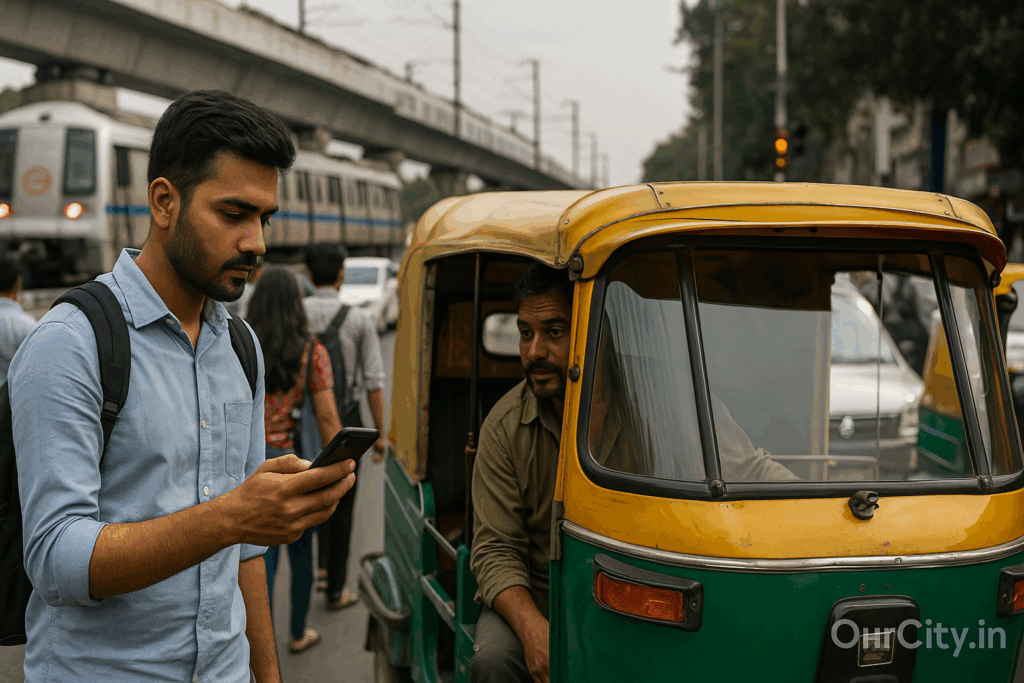
Meters: Ask for meter first, always. Typical per-km ranges are public; night surcharge is common. If they refuse, step aside and wave the next one—Delhi has supply.
-
Airport runs: Expect airport/parking surcharge. If someone quotes a flat “package,” say: “Receipt dena, main note kar raha/rahi hoon.” (रसीद देना, मैं नोट कर रहा/रही हूँ।)
-
App cabs (Ola/Uber): Better late evenings and during rain for traceability. Share trip, match photo & number plate, sit rear-left, and keep child lock glance in habit.
-
When cabs beat autos: Long cross-city hops (Dwarka ↔ Noida, Rohini ↔ Saket) or late night after 21:00 when autos bargain hard.
Polite but firm lines:
“Meter pe chaliye, warna main app se book kar lunga/lungi.”
“Bhaiya, change ready rakhiye, UPI bhi chalega?”
Peak Hours & Platform Positions
-
Peak windows: 08:30–10:30 and 17:30–20:00. Rajiv Chowk, Kashmere Gate, and Central Secretariat get packed.
-
Stand where exits are: Exit maps in the DMRC app show which gate you want. If you’re switching at Rajiv Chowk (Blue ↔ Yellow), walk with the crowd in the inner ring; for Kashmere Gate (Red/Yellow/Violet), follow “Paid to Paid” signs—standing near coach ends usually means shorter stair/elevator queues.
-
Coach choice tip: For quick exit at Hauz Khas (Magenta ↔ Yellow), coaches toward the middle-front align better with the interchange walkway.
Locals say…: Give yourself one extra train during peak—your blood pressure will thank you.
🌤 Weather Playbooks That Actually Work
Delhi’s triple season punch: blistering heat (Apr–Jun), patchy monsoon (Jun–Sep) with waterlogging pockets, and winter/smog (Nov–Jan). Treat each like a different city.
Heatwave Kit & Day Plan
-
Water & ORS: 1 sachet per 1 L bottle; sip, don’t chug. Refill at metro stations, offices, malls (Saket District Centre, Nehru Place, CP colonnades).
-
Clothing: Loose cotton/linen, light colors. Cap or UV umbrella. Dry-fit socks help in closed shoes.
-
Shade strategy: Stick to metro skywalks (Nehru Place, Sikandarpur interchange toward Gurugram is technically outside Delhi but relevant), tree-lined inner lanes in GK-I/II, Vasant Vihar, and Lutyens’ corridors around India Gate/Chanakyapuri.
-
Warning signs: Thirst + headache + dizziness = cool down now. Get indoors, sip ORS, wet a handkerchief for forehead/neck, and sit.
Heatwave Day Plan (sample):
05:45–08:30: Walking/errands.
11:00–16:30: Shade + AC tasks (malls/office/metro).
16:30–19:00: Commute home; carry an extra 500 ml.
19:30: Light, salty dinner; drink water till urine is pale.
Micro-checklist (Heat Kit):
-
1–2 L bottle + ORS
-
UV umbrella/cap
-
Sunglasses
-
Hand towel for cool compress
-
Lip balm + sunscreen
Monsoon Kit, Routes & Food Safety
-
Footwear: Quick-dry sandals or rain-friendly sneakers with grip. Avoid smooth leather soles.
-
Bags: Rain cover or zip-lock for papers; keep a spare T-shirt. Anti-fog wipe for glasses/helmet visor.
-
Waterlogging pockets (descriptive, not exhaustive): Low-lying stretches near the Yamuna, parts of Mayur Vihar, underpasses around ITO and Minto Bridge, and older market lanes (Chandni Chowk, Karol Bagh, Lajpat Central Market) post-cloudburst. Use the government traffic app/social feeds for day-of alerts.
-
Health: Dengue prevention—window screens, plug-in repellents/coils after dusk, check for standing water in balconies/pots.
-
Street food: Choose vendors with a steady queue and visible hand-washing. Piping hot > pre-cut salads in the rain.
Monsoon Day Plan (sample):
Carry foldable rain jacket; switch to metro for the last hop if your bus route is flagged for slowdowns; if water crosses ankle height, seek alternate route—don’t push a car through.
Micro-checklist (Monsoon Kit):
-
Foldable rain jacket/poncho
-
Spare socks/T-shirt
-
Zip-locks for phone/papers
-
Microfiber towel
-
Small antiseptic + band-aids
Winter/Smog Masking & Indoor Air
-
Mask type: N95/FFP2 (no valve) with snug fit. Replace when loose or soiled.
-
Timing: Prefer late-afternoon walks (15:30–17:30) over early mornings in peak smog weeks.
-
Room setup: If no HEPA purifier, DIY a basic filter—seal window gaps; a towel under the door reduces dust ingress. Keep one “clean room” for elders/kids.
-
Hydration & skin: Dry winter air needs water + moisturizer; warm water gargles help throat irritation after a smoggy commute.
AQI Actions (quick table):
| AQI Band | What You Do | Mask? | Outdoor Effort |
|---|---|---|---|
| 0–100 | Normal day | Optional | Normal |
| 101–200 | Sensitive folks caution | Consider | Light |
| 201–300 | Limit long walks | Yes | Short |
| 301–400 | Keep kids/elders in | Yes | Minimal |
| 401+ | Essential trips only | Yes (tight fit) | Avoid |
🩺 Health & Emergencies Without Panic
Hospitals, Ambulance, First Aid
-
Emergency numbers: 112 (all-in-one), 108 (ambulance)—national. Save them.
-
Where to go: Government hospitals handle trauma at scale; private hospitals offer shorter queues, higher cost. For sudden issues (severe dehydration, cuts, fractures), head to Casualty/Emergency, not OPD.
-
Carry: One physical ID + digital insurance card (policy & TPA details). Keep in a small waterproof sleeve.
-
First aid basics:
-
Dehydration/heat exhaustion: Shade, loosen clothing, small sips of ORS, fan air; if confusion/vomiting—hospital.
-
Minor cuts: Clean water wash, antiseptic, bandage.
-
Sprains: R.I.C.E.—Rest, Ice, Compression, Elevation.
-
Dog/cat bites: Wash with soap & water 10–15 min; go to hospital for tetanus/anti-rabies advice.
-
Food poisoning: Oral fluids, avoid dairy/fat; persistent vomiting or blood—see a doctor.
-
Pharmacy & Safe Self-Care
-
24×7 pockets: Areas near major hospitals (AIIMS/Green Park corridor, Saket, Rajouri Garden) often have late chemists; check maps.
-
Keep at home: ORS, paracetamol, basic antihistamine, antiseptic, thermometer, rehydration salts, band-aids, crepe bandage.
-
Reminder: Medicines have interactions—when unsure, ask a doctor/hospital.
Locals say…: A small home kit beats a midnight scramble.
🛡️ Night & Solo Safety
Women’s Compartment/Coach Pointers
-
On the metro, the women-only coach is marked and patrolled. On platforms, wait near CCTV + CISF posts. At interchange hubs (Rajiv Chowk, Kashmere Gate), follow the main flow; avoid quiet back corridors late.
App Cab vs Street Hail (When & Why)
-
After 21:00, app cabs win for traceability. Confirm plate, share trip, and stay alert at signals. If a route feels off, say: “Yahan se seedha mat lijiye, main route app par dekh raha/rahi hoon.”
Polite Refusal Scripts & Red Flags
-
Touts near stations/markets:
“Nahi chahiye, thank you.” (नहीं चाहिए, थैंक यू।)
“Main app se book kar raha/rahi hoon.”
“Police se confirm kar leta/leti hoon.” -
Pickpockets: Crowded bridges at CP, Chandni Chowk, and festival melas (CR Park puja pandals) need front-zip bags and phone in inner pocket.
-
ATMs/UPI: Scan QR carefully (QR-swap is real). Ignore unknown collect requests. Shield PIN, tug the card slot to spot a skimmer.
🏠 Housing, PGs & Utilities
Deposits, Clauses & Broker Scripts
-
Broker norms: Often 15 days to 1 month of rent as fee; deposit usually 1–2 months (varies by area—GK/South Delhi can be higher).
-
Ask clearly:
“Deposit kitna refundable hai, aur kab?”
“Maintenance mein kya-kya included hai? (RO, AC servicing, society charges?)”
“Water timing kya hai—borewell ya municipal?” -
Clauses to expect: Notice period (1–2 months), minor repairs clause, painting on move-out. Get an inventory list of appliances and meter readings on day one.
Power/Water Outage Playbook
-
Power: Summers strain load. Keep an inverter etiquette: reserve for lights/fans/router; avoid heavy appliances. Use surge protectors for fridge/computers.
-
Charging routine: Top up phone/power bank before peak evening.
-
Water: Many neighbourhoods have timed supply. Store in covered drums; maintain RO/UV on schedule; on tanker days, be at home during the slot.
Pest & Mosquito Control That Works
-
Screens on windows, drain traps closed at night, periodic gel pest control for cockroaches, and larval source reduction on balconies. After sunset in monsoon, coils or plug-ins.
📄 Paperwork That Saves You Time
Tenant Verification & Receipts
-
Police verification is a standard landlord expectation. Many local police stations provide an online form plus physical visit. Always ask for an acknowledgement slip/number. Keep a soft copy in your document locker.
E-Challan & Civic Apps
-
E-challans (traffic fines): Check via the Delhi Traffic Police portal/app using vehicle number. Pay online—keep receipt PDFs.
-
Civic complaints: Garbage pickup, potholes, streetlights—look for MCD/NDMC complaint apps and the national Swachhata app. Delhi Jal Board has grievance channels for water issues.
Locals say…: Screenshot everything. It settles half the arguments.
💸 Daily Costs & Cash-UPI Rhythm
Sample Budgets & Top-Ups
Student day (₹-wise):
-
Metro/bus return: ₹40–120 (distance-based)
-
Lunch (canteen/roll): ₹60–150
-
Tea/coffee: ₹10–30 (chai) / ₹150–300 (café)
-
Snacks/water: ₹20–60
-
Total: ₹130–630
Working day:
-
Commute (metro + short auto): ₹100–250
-
Lunch (thali/office café): ₹120–250
-
Coffee: ₹150–300
-
Misc: ₹50–150
-
Total: ₹420–950
Top-ups: Keep ₹200–500 on your metro card; recharge once weekly to avoid queues.
Emergency Cash & ID Copies
-
Contingency rule: ₹1,000–₹2,000 at home + ₹200 in your transit pouch. Keep 2 photocopies of ID (one in bag, one at home). DigiLocker + mParivahan for soft copies.
📱 Must-Have Apps & Offline Backups
Official Transport & Traffic Tools
-
DMRC (Delhi Metro) official app: Live fares/timings, maps, exits.
-
Delhi bus live-tracking (“One Delhi”): For DTC & cluster routes.
-
Delhi Traffic Police app: E-challans, advisories, tow-yard info.
-
Ride-hailing: Ola, Uber; bike taxis where legal; Rapido for short hops.
-
Maps: Save offline areas around CP, Saket–Nehru Place, Dwarka, Rohini, Shahdara, Mayur Vihar, and Aerocity.
ICE Contacts & Document Lockers
-
ICE widgets on phone lock screen (name, blood group, emergency contact).
-
DigiLocker for Aadhaar/PAN/RC/insurance.
-
mParivahan for DL/RC.
-
SOS apps: Delhi Police “Himmat” for quick alerts (use regularly, not just install).
Network quirks: Basements in CP colonnades, Old Delhi gullies, and some Nehru Place offices can have weak signal. Download ride QR/addresses before you go down.
🚗 Driving, Parking & Towing Traps
Rain Riding & Helmet Basics
-
Helmets: BIS/ISI mark visible. Replace after a crash.
-
Monsoon riding: Avoid white paint lines and metal plates. Slow in the first 20 min of rain—oil rises on roads.
-
Pothole cues: Where rain pools near curb on Ring Road/Outer Ring Road, expect hidden dips.
No-Parking Pockets You’ll Want to Know
-
Markets like Sarojini Nagar, Lajpat Central Market, Karol Bagh (Ajmal Khan Rd), and Old Delhi lanes tow fast. Use marked MCD/NDMC lots.
-
Tow-yards: Locations rotate; check the traffic police app/helpline with your vehicle number.
Airport & stations:
-
IGI Airport pickup lanes have time-bound grace; use official pick-up bays or Park & Wait at Aerocity.
-
NDLS (New Delhi Railway Station): Use the Ajmeri Gate side for quicker app-cab access in peak hours; confirm gate with your platform number.
🌊 Disaster Readiness (City-Specific)
Delhi is seismic (tremors felt periodically) and gets urban flooding in intense rain, especially near the Yamuna and underpasses.
Flood/Cyclone/Earthquake Notes
-
Heavy rain: Avoid underpasses with stalled cars; do not restart a water-logged engine. Step on firm ground—open drain covers can shift.
-
Earthquake: Drop-Cover-Hold. Stay away from glass; after shaking, use stairs, not lifts. Agree on a family meetup point (society gate, nearest park).
Go-Bag & Family Plan
Keep a small backpack near the door:
| Go-Bag Item | Why It Helps |
|---|---|
| Copies of IDs & insurance | Evacuation verification |
| 1–2 L water + ORS | Heat/flood delays |
| Power bank + cables | Comms during outages |
| Mask set (N95/FFP2) | Smog/dust |
| Basic meds & first aid | Minor injuries |
| Flashlight | Night outages |
| Small cash (₹1,000–₹2,000) | Card/UPI downtime |
| Protein bars/khakra/chikki | Quick calories |
Family plan: Share who grabs what (docs, meds, water), and one out-of-Delhi contact to update if local networks are busy.
👥 Special Playbooks
Students & Freshers
-
PG clusters: Hudson Lane (North Campus), Satya Niketan (South Campus), Lajpat/Amar Colony, Mukherjee Nagar for coaching. Check library/reading rooms; many run late.
-
Cheap eats: Roll joints in Karol Bagh lanes, momos in Safdarjung/Green Park, thalis around RK Ashram/CP.
-
Exam season: Keep soft docs (ID, admit card) in a single folder; note arrive-by times one hour earlier than printed.
Solo Women
-
Late-night: Use app cabs; wait under CCTV near metro gates or inside malls/hotel lobbies (Saket/Aerocity).
-
Elevator vs stairwell: In quiet commercial buildings (Nehru Place, Okhla), prefer elevators with CCTV; avoid isolated stairwells after hours.
-
Trusted snacks: Vacuum-sealed chikkis, nuts, electrolyte drinks in bag.
Parents with Kids
-
Parks: Lodhi Garden, Deer Park (Hauz Khas)—stroller-friendly in mornings.
-
Safe hours by season: Heat—07:00–09:00; winter—15:30–17:00.
-
Festival outings: For CR Park puja crowds, put a child-ID wristband (name + phone). Decide a reunion spot.
Elders & PWD
-
Step-free: Many metro stations have lifts; ask the CISF/DMRC staff for the closest gate-to-platform route.
-
Low-floor buses: Cluster routes on Ring Road often deploy them—confirm on the app.
-
Hospital windows: 10:30–12:00 and 15:00–17:00 are often manageable outside peak OPD.
✅ Quick Cheatsheets (Tables)
Typical Metro/Bus Costs & Pass Ideas (indicative ranges; check official apps for live fares)
| Item | Typical Range | Notes |
|---|---|---|
| Metro short hop | ₹20–60 | Distance & line dependent |
| Metro long cross-city | ₹60–100+ | Interchange may add time |
| Daily top-up | ₹200–500 | Minimize queues |
| Bus fare | Low, distance-based | Keep change/UPI |
| Airport Express | Premium vs regular | Faster, worth it at odd hours |
Peak Hours by Line (thumb rules)
| Corridor | Crowdiest Windows | Tip |
|---|---|---|
| Yellow (Samaypur Badli–HUDA CC) | 09:00–10:00 & 18:00–19:30 | Stand near exits at Rajiv Chowk |
| Blue (Dwarka–Noida/Vaishali) | 08:45–10:30 & 17:30–20:00 | Middle coaches = shorter escalator queues at CP |
| Violet (Kashmere–Raja Nahar Singh) | 09:00–10:30 & 18:00–20:00 | Use Kashmere Gate paid-to-paid signs |
| Magenta (Janakpuri–Botanical) | 09:00–10:00 & 18:00–19:30 | Good airport/Aerocity transfer |
| Red/Green/Gray | Office peaks similar | Watch platform crowding at net-interchanges |
Weather Months (Delhi)
| Month | Heat | Rain | Smog/Winter |
|---|---|---|---|
| Jan | — | — | ✅ Cold, fog possible |
| Feb | — | — | Cool, clearing |
| Mar | Warming | — | — |
| Apr–Jun | ✅ Peak heat | — | — |
| Jul–Sep | Warm | ✅ Monsoon bursts | — |
| Oct | Warm to mild | — | Smog starts late |
| Nov–Dec | Mild to cold | — | ✅ Smog & chill |
Kits at a Glance
| Kit | Must-Haves |
|---|---|
| Heat | ORS, 1–2 L water, cap/UV umbrella, sunglasses, towel |
| Monsoon | Rain jacket, zip-locks, microfiber towel, spare socks, antiseptic |
| Smog | N95/FFP2 masks, moisturizer, saline nasal spray (if doctor-approved) |
| Go-Bag | IDs, cash, power bank, flashlight, meds, snacks |
❓FAQs
1) What’s the safest late-night way from CP to South Delhi?
App cab from Rajiv Chowk gate under CCTV, share trip, stick to Aurobindo Marg → Ring Road corridors. Avoid isolated back lanes.
2) Are autos better than cabs for short hops?
Often yes for ≤3–4 km—faster to hail. Still ask: “Bhaiya, meter se chaliye.” If surge is high, autos win.
3) How do I handle a wrong UPI request?
Decline silently. Never enter PIN to “receive” money. Report on the app if needed.
4) Where do I wait for a cab at NDLS?
Try the Ajmeri Gate side for clearer pickup zones. Confirm your gate with the app.
5) What if my phone dies mid-trip?
Carry a power bank. Memorize one emergency number. Keep ₹200 cash.
6) How do I check if my car is towed?
Use the traffic police app/helpline with your vehicle number; it shows tow-yard info.
7) Which markets are crowd-heavy for pickpockets?
Chandni Chowk, Sarojini Nagar, Lajpat, and CP on weekends. Front-zip bag, phone in inner pocket.
8) Which coach should I use for quick exit at Rajiv Chowk?
Middle to front-middle coaches often align better with main escalators—watch signage and learn your gate numbers.
9) How much cash should I carry daily?
₹100–₹300 is fine for tiny vendors; the rest on UPI/card. Keep backup cash at home.
10) Can I rely on buses during heavy rain?
Yes on main trunks, but expect delays. Switch to metro for the last leg if your route floods.
11) What mask during smog?
N95/FFP2 (no valve) with tight fit. Replace when loose/soiled.
12) How do I refuse a pushy seller/driver?
“Nahi chahiye, thank you.” / “Main app se book kar raha/rahi hoon.” Short, polite, and move.
13) I lost my wallet/phone—what now?
Block cards via app/helpline, log e-FIR where applicable, use Find My tools, and visit the nearest police helpdesk at the station/market.
14) Is the women’s coach enforced?
Yes, it’s marked and monitored. If crowded, choose a mixed coach near CISF presence.
15) Any “arrive by” timings for popular spots?
Sarojini/Lajpat: before 11:00 on weekends. Old Delhi food lanes: reach 18:30 for dinner before the rush. Airport: domestic 2 h, international 3 h (add buffer on festival weeks).
🔚 Wrap-Up: You’ll Be Fine Here
Delhi has a rhythm: leave a little early, carry a small kit, know your exits, and be politely firm. The city rewards those who plan half a step ahead. Start with the metro, build your season kits, keep your apps tidy, and use the scripts without hesitation. Soon you’ll be telling newcomers exactly which gate at Hauz Khas saves five minutes—and smiling because it feels like your city now.