Dhanbad Culture Guide
Table of Contents
Dhanbad Traditions & Culture: Show Up Right
Dhanbad moves on coal and faith. Pandals glitter at Bank More and Hirapur, drums roll through Jharia and Katras, and the Damodar breeze cools Sindri after a long aarti. People from Bihar, Bengal, Odia belts, and Jharkhand’s Adivasi communities live side by side—so the calendar is full and the manners are shared. First-timers often misjudge crowd peaks, forget head covers, or get stuck near Bartand junction during immersion days. This guide keeps it simple—what to wear, when to reach, how to ask, where to stand, and how to help.
🪔 Why This Culture Guide Works for Dhanbad
You’ll find many temples, mosques, gurdwaras, and churches within a few kilometres. But information is scattered—timings on a noticeboard here, a police advisory there, a local WhatsApp forward everywhere. Here’s the thing: you don’t need everything. You need the basics done right.
- Clarity: Typical time windows, not exact minutes (those change). We nudge you to check the official noticeboard/app on the day.
- Scripts: Short, polite lines in Hindi/English you can use with volunteers.
- Seasons: Heat, monsoon, winter smog—what actually changes for aarti, namaz, mass, and processions.
- Safety: Where to stand, what to carry, how to move with kids and elders.
- Local texture: Name-drops—Saraidhela, Govindpur, Bhuli, Matkuria, Purana Bazar, Dhansar, Wasseypur, Baliapur, Moonidih, Lodna, Sijua, Kenduadih, Manaitand, Topchanchi—so you feel at home.
Locals say: “Finish the big Bank More pandals before 19:00; lanes jam after.”
🪔 Festival Calendar: What Happens When (Jan–Dec)
City Highlights Month by Month
January
- Makar Sankranti (til–gur sweets, kite pockets in Purana Bazar; small community get-togethers).
- New Year/First Sunday Mass at central churches in Bartand and Saraidhela—quiet, tidy queues.
February
- Saraswati Puja in schools and coaching hubs around Hirapur and Matkuria. Offer yellow flowers; wear simple, modest clothing.
- Mahashivratri often late Feb/early Mar—lines at Shiva temples near Bank More, Jharia, Katras.
March
- Holi/Dhulendi: Dry colours in tight lanes; protect phones. Respect elders’ spaces.
- Ram Navami: Processions in Jharia and Katras Road pockets with dhols.
April
- Ramzan (fasting) & Iftar lanes near Wasseypur, Jharia Jama Masjid area—fruity sharbat, kebab counters; be mindful around maghrib.
- Good Friday/Easter at churches in Saraidhela—silent prayers; follow pew cues.
May
- Eid-ul-Fitr: Early morning namaz at large grounds; traffic holds near Bank More–Hirapur belt.
- Buddha Purnima: Simpler observances; donation bowls at monasteries if present—give quietly.
June
- Rath Yatra (Jagannath) celebrated by Odia and Bengali communities—watch chariot pulls at Sindri side or neighbourhood lanes.
- Pre-monsoon heat—plan aartis early.
July
- Muharram processions: taziya routes through Jharia, Katras, sometimes Wasseypur stretches—stand clear, keep phones away.
- Sawan Somvar at Shiva temples—Monday crowd surges after 18:00.
August
- Janmashtami midnight aartis; bhog queues at Shakti Mandir (Bank More) and other Krishna temples.
- Independence Day flag hoisting at schools/grounds—dress neat, carry water.
September
- Ganeshotsav: Pandals at Bank More, Hirapur, Saraidhela lanes; visarjan traffic to Bekar Bandh and other water bodies.
- Karam (Adivasi festival): community dancing; be an observer, ask before filming.
October
- Durga Puja/Navratri: The big week. Pandal circuit: Bank More, Hirapur, Matkuria, Jharia market, Katras, and housing colonies in Bhuli/Govindpur. Sindoor khela on Dashami—photograph respectfully.
- Ramlila/Dussehra grounds near Manaitand and other maidans.
November
- Diwali/Kali Puja: Diyas, fireworks advisories by city police; Kali Puja strong in Bengali pockets like Purana Bazar/Matkuria.
- Chhath Puja: The soul of the region—ghats at Bekar Bandh, stretches of Damodar near Sindri, and lake edges near Topchanchi/Panchet. Absolute calm—no loud music, no selfies during araghya.
December
- Christmas: Midnight Mass at churches in Saraidhela/Bartand; pudding stalls outside.
- New Year’s Eve: Family prayers; keep travel sober and pre-book rides.
Where to Go & When to Arrive (Time Cues)
- Morning aarti: Pre-dawn to 07:30 first slot. Tip: reach by 05:45 on major tithis to get a calm 10 minutes.
- Evening aarti: Around sunset—typically 18:15–19:15. Avoid 18:00–20:00 surge in festival weeks.
- Jummah (Friday) namaz: Early afternoon; plan to clear Bank More and Jharia bottlenecks by 12:45.
- Sunday mass: Commonly 06:30–08:30 and one evening mass; check the church noticeboard that day.
- Visarjan days: Start early. If you must watch, stand near barricaded corners by Bekar Bandh or designated ponds; avoid narrow chaurahas.
Family-, Senior-, and Child-Friendly Tips
- Strollers: Not practical in Purana Bazar or Wasseypur lanes; baby-wear or use a light sling.
- Elders: Choose side benches under shamianas. Many pandals keep a senior lane—ask, “Buzurgon ke liye alag line hai? (बुज़ुर्गों के लिए अलग लाइन है?)”
- Kids: Drums get loud. Carry foam earplugs; feed them before you enter queues.
- Meet-up point: Fix a stall or pandal gate as a family marker—“Meet at Matkuria crossing tea stall.” Write a phone number and tuck into the child’s pocket.
Locals say: “Bekar Bandh before sunrise during Chhath feels sacred—go quiet, go light.”
🪔 Sacred Spaces Etiquette (Temples • Gurdwaras • Dargahs/Mosques • Churches • Ghats)
Dhanbad’s sacred map is compact. You can move across Bank More–Hirapur in minutes on an e-rickshaw and reach Jharia, Katras, Sindri, or Govindpur in short rides. Respect is the same everywhere: modest dress, calm voice, patient feet.
Temples: Simple Steps That Matter
- Footwear: Use the shoe racks. In summer, floors burn—carry socks.
- Dress: Cover shoulders and knees; light cottons in May–June. Keep a small dupatta/angochha for head cover if needed.
- Queues & tokens: Some popular shrines—like Shakti Mandir (Bank More)—may issue tokens at peak hours. Ask volunteers, follow ropes.
- Prasad handling: Take with the right hand. If sugary prasad doesn’t suit you, accept and share outside.
- Aarti behavior: Hands up, phones down. Don’t stretch your arm over the flame.
Gurdwaras: Head, Hands, Heart
- Head covering: Mandatory. Use your scarf or ask for a spare rumal near the jora ghar (shoe area).
- Karah prasad: Accept both palms joined; don’t waste.
- Langar: Sit in pangat (rows). Eat what is served; say softly if you want less. Offer seva—from washing utensils to spreading mats.
Dargahs & Mosques: Quiet Steps, Covered Heads
- Head covering: Carry a scarf/cap. Women’s sections may be separate.
- Offerings: At dargahs, a chadar (₹200–600) or flowers are common. Keep it simple; no display.
- Namaz: Avoid crossing lines. During azan or namaz, stay to the side or outside.
Churches: Silence First
- Entry: Switch phones to silent. Follow kneel/stand cues by watching the front pews.
- Candles: Place carefully; keep children at a distance from open flames.
- Confession/private prayer: Small rooms—wait your turn, speak softly.
River Ghats & Cremation Grounds
- Ghats: At Bekar Bandh, Damodar stretches near Sindri, or lakes around Topchanchi/Panchet, keep a metre from the water edge. No coins, no tossing plastic.
- Cremation grounds: Keep distance, no photos, speak in whispers, move with care.
What to Wear & Carry (Across Traditions)
- Wear: Light cottons, full-length trousers/salwar, dupatta/scarf, simple footwear that comes off quickly.
- Carry: Small scarf, socks (hot floors), refillable bottle, handkerchief, wet wipes, tiny cloth bag for offerings, a few ₹10/₹20 notes for small daan.
- Avoid: Loud perfume, noisy jewellery, backpacks inside tight sanctums.
Offerings/Prasad/Chadar: Ranges & Rules
- Flowers: ₹20–100 near Purana Bazar, Hirapur lanes.
- Prasad boxes: ₹20–60—read labels for ingredients if you’re fasting.
- Oil/ghee packs: ₹50–200; hand over with right hand.
- Chadar at dargahs: ₹200–600; share credit among friends if needed.
- Hundi/daan: Give quietly; UPI boxes are common. No flaunting cash.
Photography & Phone Etiquette
- Ask first, click later. Avoid faces during sensitive rites. No flash near aarti flame. Never push your phone above a priest/qawwāl/Granthi.
Ask Politely (Ready Scripts)
- “Photography allowed hai?” (फ़ोटोग्राफी अलाउड है?)
- “Queue kahan se shuru hoti hai?” (क्यू कहाँ से शुरू होती है?)
- “Darshan token yahin milta hai?” (दर्शन टोकन यहीं मिलता है?)
- “Head cover kahaan milega?” (हेड कवर कहाँ मिलेगा?)
- “Langar kahaan serve ho raha hai? Main seva kar sakta/sakti hoon?” (लंगर कहाँ सर्व हो रहा है? मैं सेवा कर सकता/सकती हूँ?)
Reminder: Timings and routes change. Check the day’s noticeboard, volunteers’ mic announcements, or the temple/mosque/church committee’s official page.
🪔 Processions, Melas & Community Events
Safe Viewing Spots & Exit Plans
- Durga Puja & Ganesh Visarjan: Barricades near Bekar Bandh and designated ponds. Choose the edge, not the centre. Keep an eye on the nearest open lane.
- Muharram & Ram Navami routes: On Jharia Road, Katras Road, and Wasseypur stretches—stand behind railings; don’t squeeze into taziya paths.
- Chhath: Absolute discipline at ghats near Sindri and Bekar Bandh—stand behind families offering araghya; no jostling.
- Melās: Grounds at Manaitand, Bhuli, or colony maidans—learn the entry/exit gates. Fix a regroup point.
Transport Diversions & Crowd Windows
- Dhanbad has no metro; your friends are e‑rickshaws, autos, and buses. On big nights, Bank More chokes fast.
- Best movement window: 16:00–18:00 pre-peak or 21:30–22:30 post-peak for pandal hopping.
- Traffic advisories: On immersion days and Chhath, certain bridges and circles near Hirapur, Matkuria, Govindpur can shut temporarily—listen for police PA announcements.
If You Get Separated (Meet-up Scripts)
- “Main gate ke left wale chai stall pe milte hain.” (At the tea stall left of the main gate.)
- “Mandap ke baahar wali medical tent pe wait karo.” (Wait at the medical tent outside the mandap.)
- For kids: Write a contact number, tuck into pocket; teach them: “Police/volunteer ko dikhao.”
Locals say: “In Wasseypur, let processions pass. Two minutes of patience saves ten minutes of traffic.”
🪔 Seva, Daan & Doing Your Bit
Simple Ways to Volunteer
- Shoe-rack help: Quick rotation keeps queues moving.
- Langar service: Dry your hands, serve small portions first. Offer to refill water.
- Queue management: Ask the committee before guiding. Smile, point, repeat.
- Post-event cleanups: Bring gloves; separate wet/dry waste; avoid stepping on flowers/garlands.
Hygiene & Clean-up Etiquette
- Carry a small trash pouch. Dump only in designated bins. Don’t throw coins or plastic in Bekar Bandh or river stretches.
Digital UPI vs Cash (When & How)
- UPI boxes: Fast and transparent; screenshot the receipt if offered.
- Cash: Keep ₹10–₹50 notes for small offerings and community boxes. Use the right hand. Avoid public counting.
🪔 Arts, Crafts, Music & Dance of Dhanbad
Dhanbad leans mining and mercantile, but culture breathes in every lane.
What to See Live (Rehearsals, Sabhas, Baithaks)
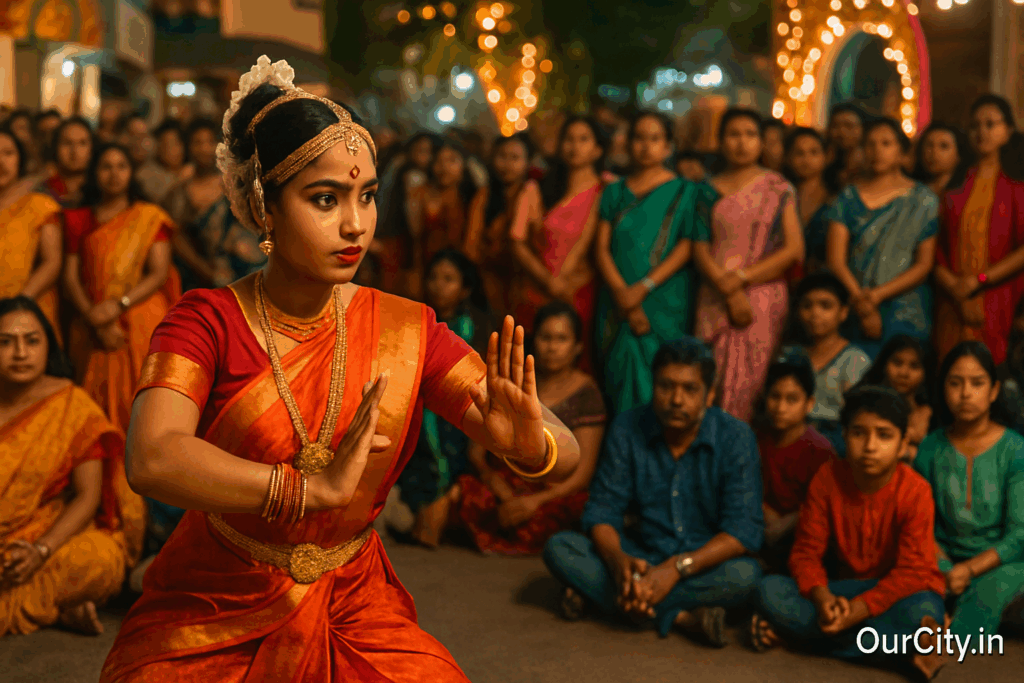
- Jhumar & Nagpuri dance teams often rehearse in colony grounds around Bhuli and Jharia before festive stages—ask a senior if watching is okay.
- Kirtan & Bhajans in Bank More/Hirapur community halls during Navratri. Quiet claps, no loud chatter.
- Qawwali evenings at select dargahs near Wasseypur/Jharia—men and women may sit separately; keep phones discreet.
- School/college sabhas around Saraidhela/IIT(ISM) campus during Saraswati Puja—respect campus rules.
Ethical Souvenir Buying (Quick Tests & GI Mentions)
- Prefer stalls that explain the craft. Ask, “Yeh handmade hai ya factory?”
- Sohrai/Kohvar tribal art (seen widely in Jharkhand) is sometimes sold at city melas—look for brush strokes, not uniform prints.
- Handloom picks: cotton towels, stoles, and occasional tussar silk sellers from nearby Bihar—bargain respectfully.
- Avoid plastic trinkets that become litter by next week.
Locals say: “At Purana Bazar, ask for the old mithai shop that still does fresh tilkut.”
🪔 Language, Greetings & Everyday Manners
Dhanbad speaks many tongues. A little effort goes a long way.
Local Phrases (Transliteration + Script)
- Namaste/Pranam (नमस्ते/प्रणाम) — universal, polite.
- Johar (जोहार) — common greeting among Adivasi communities.
- Adaab (अदाब) — Urdu greeting used warmly.
- Nomoskar (নমস্কার) — Bengali greeting; heard in Purana Bazar/Matkuria pockets.
- Dhanyavaad (धन्यवाद) / Shukriya (शुक्रिया) — thank you.
- Maaf kijiye (माफ़ कीजिए) — excuse me/sorry.
- Haan/Na (हाँ/ना) — yes/no.
- Paani kahaan milega? (पानी कहाँ मिलेगा?) — where can I get water?
Right-Hand Giving, Thresholds, Sacred Trees/Animals
- Offer and receive with the right hand (or both palms).
- Don’t step on thresholds or touch idols.
- Respect sacred trees (peepal, banyan) and cows—no teasing, no littering.
What Not to Do (Short List)
- Don’t fly drones near processions or shrines.
- Don’t argue with volunteers. If in doubt, step aside and ask.
- Don’t block aarti flame with your phone.
- Don’t bring loudspeakers of your own.
🪔 Seasonal Playbooks (Heat • Monsoon • Winter/Smog • Peak Festive)
What Changes, What to Pack, When to Go
Summer (Apr–Jun)
- Heat plan: Earliest darshan slots; carry ORS sachets. Floors get hot—socks help. Aim for shade in Bank More pandals.
- Dress: Breathable cotton, cap/scarf.
- Water: Refill at RO points where available; avoid single-use plastic.
Monsoon (Jun–Sep)
- Footwear: Non‑slip sandals; carry a small poly cover for offerings.
- Routes: Watch for waterlogging near Jharia Road and Katras Road.
- Pandals: Prefer covered mandaps; keep phones in zip pouches.
Winter/Smog (Nov–Jan)
- Layer: Light sweater for pre‑dawn aarti, especially near Bekar Bandh.
- Masks: N95/FFP2 if you’re sensitive to smoke during Diwali/bonfires.
- Elders: Warm seating near side walls, away from open doors.
Peak Festive Weeks (Durga Puja, Chhath)
- Plan transport: Book autos for pick‑and‑drop; confirm via call/SMS.
- Quiet hours: Early mornings and late nights (post‑22:00) are calmer for pandal hopping.
- Kids: Avoid the 18:00–20:00 crush entirely.
Exam & Job‑Hunt Season
- Seek calm corners in temple courtyards during off‑hours; libraries near Saraidhela sometimes stay open late—check boards first. Offer a quick prayer and move on.
🪔 Quick Cheatsheets (Tables)
Festival Months vs Typical Timings
| Festival | Typical Months | Key Time Cues |
|---|---|---|
| Saraswati Puja | Jan–Feb | School/college hours; aarti 07:00–08:00 & 18:30–19:30 |
| Mahashivratri | Feb–Mar | Night queues; best 05:30–06:30 |
| Holi | Mar | Mornings; avoid 11:00–14:00 crowd splash |
| Ramzan/Iftar | Apr–May | Sunset to maghrib; be discreet near mosques |
| Eid-ul-Fitr | Apr–May | Early namaz; dispersal by 09:30 |
| Rath Yatra | Jun–Jul | Afternoon chariot pulls; keep to edges |
| Muharram | Jul–Aug | Evening processions; no photos without consent |
| Janmashtami | Aug–Sep | Midnight aarti; arrive by 22:30 |
| Ganeshotsav | Sep | Evening aartis 18:30–20:00; visarjan day diversions |
| Karam | Sep | Community dance; observe quietly |
| Durga Puja | Sep–Oct | Peak 18:00–21:00; best 06:00–08:00 |
| Diwali/Kali Puja | Oct–Nov | Diyas at dusk; watch firework advisories |
| Chhath | Oct–Nov | Sunrise/sunset araghya; absolute silence |
| Christmas | Dec | Midnight mass; arrive 23:15 for seating |
Etiquette by Place of Worship
| Place | Head Cover | Footwear | Photography | Offerings | Notes |
| Temple | Optional (women often cover) | Leave at rack | Ask; avoid during aarti | Flowers, prasad, oil/ghee | Hands up, phones down during aarti |
| Gurdwara | Mandatory | Leave at jora ghar | No inside sanctum | Head cover; karah prasad | Sit in pangat at langar |
| Dargah/Mosque | Recommended/Required | Outside | Very limited; ask | Chadar, flowers | Gendered areas possible |
| Church | Not required | Keep on (quietly) | Usually no during mass | Candles | Follow kneel/stand cues |
| Ghats | Not required | Footwear okay away from water | Avoid during rites | Flowers/diya (eco‑friendly) | Keep distance; no selfies |
Offering/Donation Ranges (₹)
| Item | Typical Range |
| Flowers | ₹20–100 |
| Prasad boxes | ₹20–60 |
| Oil/Ghee packs | ₹50–200 |
| Chadar (dargah) | ₹200–600 |
| Candles/Diya sets | ₹10–30 |
| Community daan | As you wish (small notes help) |
Quiet-Hour Windows & Crowd Surges
| Slot | Quieter Window | Avoid Window |
| Morning aarti | 05:45–06:30 | 07:00–08:00 |
| Evening aarti | 17:30–18:00 | 18:00–20:00 |
| Pandal hopping | 06:00–08:00 / 22:00–23:00 | 18:00–21:00 |
| Ghats (Chhath) | Pre‑sunrise staging | Araghya minutes |
🪔 FAQs (Real Questions, Fast Answers)
1) What should I wear for most Dhanbad shrines?
Light cottons, covered shoulders/knees, easy footwear. Carry a small scarf.
2) Are phones allowed during aarti/namaz/mass?
Keep on silent. No phone use during the main rite. Ask first for photos.
3) Is cash still needed if UPI is everywhere?
Yes—carry ₹10–₹50 notes for small offerings or queue boxes. Use UPI for larger daan.
4) Solo-female tips at night during Puja?
Stick to lit stretches like Bank More–Hirapur. Stand near families. Pre‑book rides; share trip with a friend.
5) Can I attend langar if I’m not Sikh?
Yes. Sit in pangat, accept what is served, don’t waste food. Offer seva if you can.
6) Where do visarjans go?
Designated ponds/lakes like Bekar Bandh and notified water bodies. Follow police diversions.
7) Are drones allowed near pandals or ghats?
No. They disturb rituals and can be illegal without permits.
8) What about loudspeakers at night?
City or police advisories may restrict timing and volume. Respect local rules.
9) Best time to see Durga Puja pandals calmly?
Early morning 06:00–08:00, or late night 22:00–23:00.
10) Can I bring kids to Chhath ghats?
Yes, but keep them behind the front line, hold hands, and leave right after araghya.
11) How do I ask about a special queue for elders?
“Buzurgon/Divyang ke liye line hai?” (Is there a line for seniors/persons with disabilities?)
12) Any food prices near venues?
Tea ₹10–20, samosa ₹12–20, litti‑chokha plate ₹40–80, water pouches ₹5–10 (prefer refill bottles).
13) Transport fares across short hops?
E‑rickshaw shared seats ₹10–20; point‑to‑point autos ₹60–120 within 3–5 km, depending on traffic.
14) Where to stand in processions?
Edges near barricades, with a clear exit. Don’t climb on vehicles/statues.
15) What if photography isn’t allowed and I clicked by mistake?
Say, “Maaf kijiye, allowed nahi tha—main delete kar deta/deti hoon.” Then delete.
🪔 Wrap-Up: You’ll Fit Right In
Dhanbad respects simple manners. Reach on time, dress modestly, speak gently, and pitch in. Whether you’re at Shakti Mandir flame, a Wasseypur qawwali, a Bhuli langar, or the silent line at Bekar Bandh during Chhath, remember: patience is prayer here. Check the day’s noticeboard, listen to volunteers, carry small notes, keep your phone down—and you’ll feel like a local within a week.
Locals say: “Get your aarti done before sunset—and your chai after.”